
Metacognitive Skills: Learning to Manage Your Own Thinking
Nov 06, 2026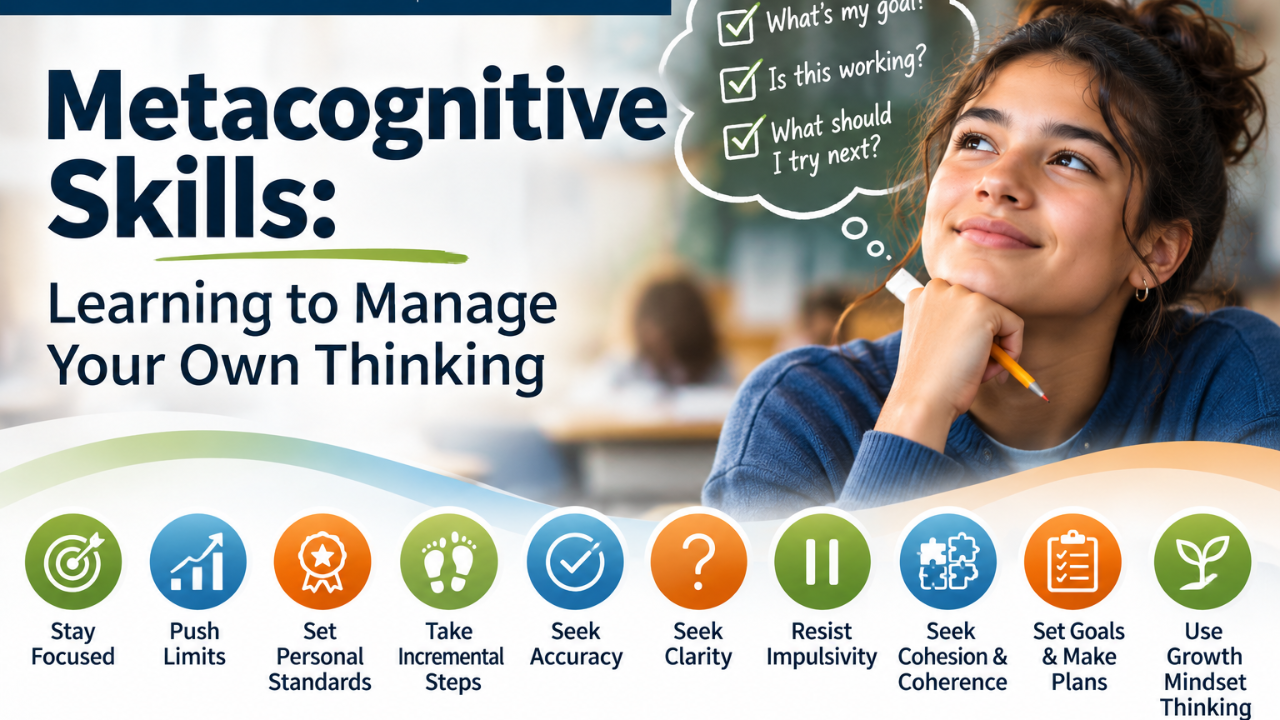
Ask a student what they did when they got stuck on a difficult task, and you may hear something like, “I just kept trying.” That sounds encouraging. We want students to develop a perseverance mindset. But what exactly did the learner keep trying? Did they recognize why the original strategy was not working? Did they consider another approach to move around the obstacle monsters keeping them from advancing?
There is a difference between working hard and managing your thinking to become more effective and efficient at completing tasks. The skills to do so are the root of metacognition.
Metacognition is often described as thinking about your thinking. That definition is useful as a starting point, but it can also make the concept sound more abstract than it needs to be. In Dimensions of Thinking, Marzano and his colleagues described metacognition in terms of knowledge and control of oneself and knowledge and control of the processes being used. Learners need to recognize what is happening in their thinking and then do something useful with that awareness (Marzano et al., 1988).
First, the learner must realize, “I have been trying the same thing three times, and it still is not working.” This important step is about gaining awareness. Then the learner asks, “What is stopping me? Do I need more information, a different strategy, or some help?” Now they are beginning to regulate the process. That is where metacognition becomes useful.
Why: Awareness Is Not Enough
Schools ask students to regulate their own learning all the time. We expect them to stay focused when something is difficult, check the accuracy of their work, recognize confusion, set goals, develop plans, resist jumping to conclusions, and decide when a strategy needs to change. Yet many of those expectations are communicated as reminders rather than taught as skills. A teacher might say things like, “Slow down,” “Check your work,” “Don't give up,” and my personal favorite, “Pay attention.” Each direction describes something we want from the learner, an outcome. But it does not necessarily tell the learner how to accomplish it.
This matters because metacognitive skills are not simply personality traits that some students possess and others do not. The Marzano Academies model treats them as teachable skills. The proficiency-scale materials go so far as to describe metacognitive skills as a curriculum for success both in school and in life because the same processes students use to manage difficult academic work can transfer to situations outside of school.
Dimensions of Thinking describes three forms of knowledge that contribute to metacognition. Declarative knowledge is knowing what. Procedural knowledge is knowing how. Conditional knowledge involves knowing when and why to use a particular strategy (Marzano et al., 1988).
Consider the skill of seeking clarity. A learner may understand that seeking clarity means identifying what they do not understand. That is useful knowledge about the skill. But successful use of the skill requires more. The learner has to be able to stop, identify the specific point of confusion, determine what information might resolve it, and take an appropriate action. Eventually, the learner also needs to recognize the kinds of situations in which this strategy is useful. That is procedural and conditional knowledge.
The same is true for resisting impulsivity, setting goals and making plans, or staying focused when an answer is not immediately apparent. Students have something they actually need to learn how to do.
Recent research continues to support the importance of this capacity. He and colleagues (2024) examined longitudinal studies involving more than 71,000 students and found that students' initial levels of metacognition were positively associated with later academic achievement. The relationship was meaningful across different ages and educational settings, although an association by itself does not tell us that metacognition alone caused the later achievement.
The Education Endowment Foundation's current evidence review reaches a practical conclusion that fits closely with Bob's framework. Its review of 355 studies identifies metacognition and self-regulation as a high-impact approach and emphasizes explicitly teaching learners strategies for planning, monitoring, and evaluating their learning. Importantly, the recommendation is to teach these processes within normal academic learning rather than as disconnected thinking exercises.
In other words, teachers should not merely hope students become more self-regulated as they get older. We can help them learn how.
How: From Thinking About Thinking to Managing Thinking
One of the useful ideas in Bob's early work is that metacognition involves what he and his colleagues called executive control. That control includes evaluating where you currently are, planning what you will do, monitoring whether it is working, and making adjustments when necessary (Marzano et al., 1988). That can happen before, during, and after learning.
- A learner beginning a research task might ask, What do I already understand? What information am I missing? How will I approach this?
- During the work, the questions change: Is this strategy getting me where I need to go? Is this source trustworthy? What part is still confusing me?
- Afterward, the learner can evaluate the outcome: Did the approach work? What would I keep? What would I change next time?
This is more than completing a reflection sheet after the learning is finished. It is the ongoing regulation of thought and action while pursuing a goal. The Marzano Academies model makes this more concrete by identifying ten specific metacognitive skills. They are:
- Staying focused when answers and solutions are not immediately apparent: recognizing difficulty without simply disengaging.
- Pushing the limits of one's knowledge and skills: deliberately taking on challenges that require growth.
- Generating and pursuing one's own standards for performance: identifying criteria for what successful work should look like.
- Taking incremental steps: breaking a complex goal into manageable parts while maintaining awareness of the larger goal.
- Seeking accuracy: checking the reliability of information and the quality of one's own conclusions.
- Seeking clarity: recognizing confusion and determining what needs to become clearer.
- Resisting impulsivity: delaying a conclusion or action long enough to gather and consider relevant information.
- Seeking cohesion and coherence: monitoring whether individual parts continue to fit together and support the intended whole.
- Setting goals and making plans: identifying an intended outcome, developing a pathway, monitoring progress, and adjusting as necessary.
- Using growth mindset thinking: recognizing situations in which beliefs about one's abilities may prevent continued effort and development.
Looking across that list, something important becomes apparent. These are not simply skills for “being a good student.” They are skills for managing yourself while trying to accomplish something. Imagine a student designing a science investigation. The learner may need to seek clarity about a variable, resist drawing a conclusion from the first result, seek accuracy when interpreting evidence, take incremental steps while carrying out the procedure, and remain focused when the results do not match the original prediction.
The student is still learning science. Metacognition helps the learner manage the thinking required to do the science well.
The same skills can appear in very different contexts. A learner writing an essay may need to seek cohesion and coherence. A mathematics student may need to stay focused when a solution is not immediately apparent. A student working on a personal project may need to set goals and make plans, establish personal standards, and adjust those plans when an obstacle appears.
This is one reason Bob describes these skills as highly transferable.
What: Teach the Skill, Then Gradually Release the Control
There is a potential problem with any conversation about metacognition. We can tell students they should become independent learners and then expect independence before they have developed the skills necessary to manage it. The teacher still matters in the learning system and should provide the appropriate supports to ensure students develop skills to manage their thinking.
The 2025 Education Endowment Foundation guidance emphasizes explicit teaching, teacher modeling, scaffolding, and the gradual development of more independent use of metacognitive strategies. Teachers might think aloud while solving a problem, make the self-questions behind a strategy visible, or provide prompts that are gradually removed as students become more capable of regulating the process themselves. That aligns closely with the progression built into the Marzano Academies proficiency scales.
Consider the skill of staying focused when answers or solutions are not immediately apparent. At one level, a learner may need a teacher-provided strategy. As the learner develops, they are expected to recognize when their focus has broken down, use a more sophisticated process involving self-analysis, and eventually identify situations in which the skill is needed and evaluate how effectively they used it. The goal is for the learner to eventually recognize, I am starting to disengage. I know what is getting in my way, and I have some strategies I can try before I give up.
In Mindsets & Skill Sets for Learning, Zima describes agency as the perceived ability of an individual, based on their capacity, to shape their life. Belief matters, but the definition also includes capacity. Learners need actual skills that allow them to make decisions and act when the path toward a goal becomes difficult. Metacognition helps provide that capacity.
Over the next several theory blogs, we will look more closely at each of the ten metacognitive skills in the Marzano Academies model. We will examine what the skill requires cognitively, what the proficiency scales tell us about how it develops, and what current research adds to our understanding. The following week's Use It Tomorrow blog will then bring that thinking into the classroom. Because if we want students to regulate their learning, we cannot simply tell them to take more responsibility for it. We have to help them develop the skills that make that responsibility possible.
Continue Your Learning
The explicit teaching of the thinking skills is a component of the Marzano Academies Competency-Based Instructional Model. To continue building your understanding of effective, evidence-based, competency-based instructional practices and the full Marzano Academies instructional model, become a member of the Learning Lab. For only $10 per month, Members can access Dr. Marzano’s research Folios, professional learning resources, and practical tools designed to help teachers make competency-based practices work in real classrooms. The Learning Hub also includes Badging Experiences that allow teachers to identify a meaningful professional growth goal, strengthen their classroom routines, and document their growing expertise. Teachers should own their professional learning, and the Learning Hub is built to support that work. You can also sign up for Virtual Office Hours or engage in a CBE Coaching Series with Marzano Academies Faculty to deepen your team’s approach to a personalized, competency-based classroom. Please reach out with any questions.
References
Education Endowment Foundation. (2025). Metacognition and self-regulated learning (2nd ed.). Education Endowment Foundation.
He, G., Chen, S., Lin, H., et al. (2024). The association between initial metacognition and subsequent academic achievement: A meta-analysis of longitudinal studies. Educational Psychology Review, 36, 81. https://doi.org/10.1007/s10648-024-09922-w
Marzano, R. J., Brandt, R. S., Hughes, C. S., Jones, B. F., Presseisen, B. Z., Rankin, S. C., & Suhor, C. (1988). Dimensions of thinking: A framework for curriculum and instruction. Association for Supervision and Curriculum Development.
Marzano Academies. (2020). Metacognitive skills: Proficiency scales organized by skills. Marzano Academies.
Zima, W. (2021). Mindsets & skill sets for learning: A framework for building student agency. Marzano Resources.