
CPR Step Two: Process — Where Learning Either Lives or Dies
Feb 19, 2026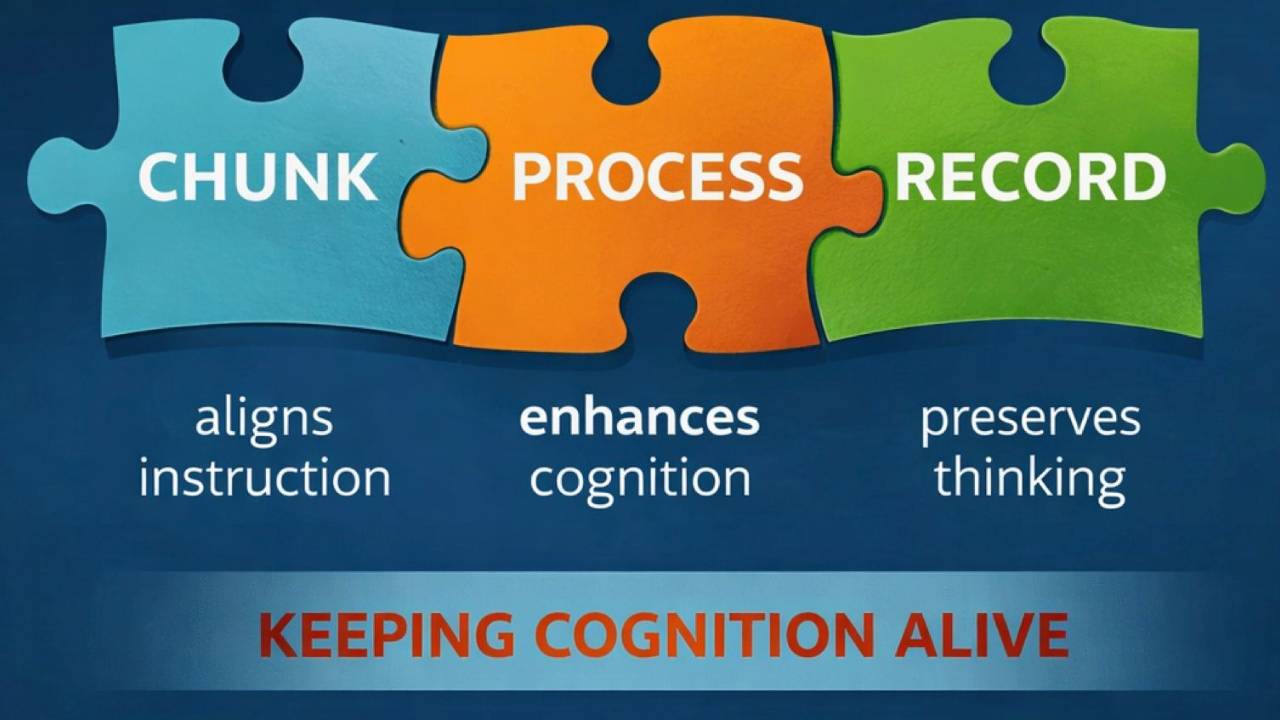
In a previous blog post, we introduced the first three elements of Desing Area III of the Marzano Academies Instructional Model, Chunk-Process-Record (CPR), as a way to keep cognitive engagement alive in the classroom.
Chunking aligns instruction with the limits of working memory.
Recording preserves thinking.
But it is the processing step that determines whether information becomes learning or simply passes through. Too often, classrooms move quickly from presentation to “engagement.” Students talk. They complete an activity. They appear busy. Yet the activity itself becomes the goal rather than the thinking it was meant to provoke.
Processing is not activity. Processing is cognitive work. And if there is no artifact of thought, we should question whether processing, or cognitive engagement, actually occurred with our learners.
What Processing Means in a Competency-Based Classroom
In Design Area III of the Marzano Academies instructional model, which was developed by Dr. Marzano specifically to support competency-based classrooms, Element IIIb: Processing Content makes this clear. He states that when new content is presented to students, they must actively process it to understand it and integrate it into their existing knowledge base. We need them to connect the new learning with previous learning. If we want students to value and internalize the content, we must provide time for them to think about it. They have to wrestle with it.
Processing occurs between chunks. It is the deliberate pause where learners:
- Generate summary statements
- Ask clarifying questions
- Make predictions
- Engage in structured group-processing strategies
Notice the verbs: generate, ask, make, engage. These are acts of cognition, not compliance. Processing is the bridge between exposure and understanding.
Why Processing Is Non-Negotiable: The Cognitive Science
- Working Memory Is Limited
Cognitive Load Theory (Sweller, 1988) reminds us that working memory can hold only a small amount of information at one time. Chunking protects against overload. But without processing, even well-chunked information fades quickly. Learners need time to connect chunks to one another and to prior knowledge, organizing them into coherent mental models that can function as a single unit in long-term memory.
- Retrieval Strengthens Learning
Research on retrieval practice (Roediger & Karpicke, 2006) demonstrates that generating summaries, asking questions, and predicting outcomes strengthen memory more than passive review. Processing forces retrieval and reconstruction.
- Elaboration Builds Schema
When students generate clarifying questions or make predictions, they elaborate on new knowledge, connecting it to prior schema (Chi, 2009). Elaboration deepens encoding.
- Metacognition Improves Transfer
Processing requires students to ask:
- What do I understand?
- What is unclear?
- What might come next?
This activates metacognitive monitoring (Flavell, 1979), which increases transfer and long-term retention.
In short:
If students do not process, they do not integrate.
If students do not integrate, they cannot transfer.
The Four Core Processing Moves
Dr. Marzano identifies four primary pathways for processing. Each one aligns directly with cognitive science.
- Generating Summary Statements
Summarizing forces students to:
- Distill main ideas
- Identify relationships
- Omit trivial details
Teaching students to recognize these patterns is powerful because comprehension depends on recognizing structure (Meyer, 1975). A summary is not a retelling. It is structured thinking.
- Asking Clarifying Questions
Clarifying questions expose cognitive gaps. The act of asking the question is often more powerful than receiving the answer. Students become aware of what they do not yet understand. Dr. Art Costa, developer of the Habits of Mind, stated that the important thing is not how a student declares the right answer, but how a student responds when he or she does not know the answer. This aligns with the concept of desirable difficulty (Bjork & Bjork, 2011). Productive confusion prompts deeper encoding. If no student can articulate confusion, either the content was trivial, or it was not processed.
- Making Predictions
Prediction is not guessing. It is hypothesis generation grounded in what learners already know. When students predict, they activate prior knowledge and test emerging mental models against new information. This aligns with generative learning theory (Fiorella & Mayer, 2015), which demonstrates that learning improves when students actively generate relationships rather than passively receive them.
Prediction requires intellectual commitment. Students must articulate what they think will happen next and why. In doing so, they expose their reasoning to confirmation or revision. Unlike pure discovery approaches that rely on minimal guidance, processing through prediction is anchored in prior knowledge and structured teacher support. Students are not left to wander toward insight; they are prompted to extend and refine what they already understand.
- Group-Processing Structures
Structured group-processing strategies such as:
- Perspective Analysis
- Thinking Hats (de Bono, 1999)
- Jigsaw
- Reciprocal Teaching
- Concept Attainment (Bruner et al., 1956)
- Think-Pair-Share (Lyman, 1981)
- Scripted Cooperative Dyads (Dansereau, 1988)
These are not engagement tricks. They are cognitive scaffolds. However, there is a danger: Students can become proficient at performing the structure without engaging in the thinking. This is where your CPR model becomes essential.
Next week in our Use-it-Tomorrow Blog, we will discuss strategies, even some popular ones, that will ask you to refocus the purpose of the strategy on cognitive engagement. Below is an example.
The Critical Distinction: Processing Strategy vs. Processed Thinking
A classroom may use Think-Pair-Share and still fail to process content. Why? Because the structure was implemented, but the thinking was not captured. If students
- Talk but produce no summary (Artifact of thought)
- Ask surface-level questions without refinement
- Predict without justification
- Engage in discussion without synthesis
…then the activity has replaced cognition. Processing requires evidence!! Which leads us to the next CPR move: Record. We will cover that element of the instructional model in upcoming blogs.
Processing in a Competency-Based System
In a competency-based classroom, processing is directly tied to proficiency scales. Students must:
- Explain what they learned.
- State what remains unclear.
- Describe the generalizations or principles emerging.
Cognitive processing skills are not “soft skills.” They are measurable cognitive behaviors. Processing can be observed. It can be evaluated. It produces visible evidence in student thinking. The teacher self-evaluation scale included in the Instructional Impact Guide, available through subscription in the Learning Hub, makes this explicit. Applying-level processing is not defined by whether the teacher used a strategy. It is defined by whether the majority of students are experiencing the desired cognitive effects. In other words, the question is not, did I facilitate discussion? The question is, did students think in ways that deepen understanding?
The Instructional Impact Guides for all 49 elements of the model, available with a subscription to the Learning Hub, provide the performance scales, reflection tools, and student-evidence indicators that move this work beyond theory. They help teachers determine not simply whether a strategy was used, but whether it produced measurable cognitive impact. Processing is not about teacher moves. It is about student evidence.
The Question That Should Guide Us
When planning a lesson, instead of asking, “How will I keep students engaged?” ask, “What cognitive work will students do between chunks, and what artifact will prove that thinking occurred?” If we cannot answer the second question, we are likely designing for activity rather than learning. And CPR is never about jut activity. It is about keeping cognition alive.
References
Bjork, R. A., & Bjork, E. L. (2011). Making things hard on yourself, but in a good way: Creating desirable difficulties to enhance learning.
Bruner, J. S., Goodnow, J. J., & Austin, G. (1956). A study of thinking. Wiley.
Chi, M. T. H. (2009). Active-constructive-interactive: A conceptual framework for differentiating learning activities.
Costa, A. L. (2015). Habits of mind. Accessed at https://habitsofmindinstitute.org/wp-content/uploads/2015/08/Habits-of-Mind-w-icons-and-eduplanet.pdf on July 22, 2020.
Dansereau, D. F. (1988). Cooperative learning strategies.
de Bono, E. (1999). Six thinking hats. Back Bay Books.
Fiorella, L., & Mayer, R. E. (2015). Learning as a generative activity. Cambridge University Press.
Flavell, J. H. (1979). Metacognition and cognitive monitoring.
Lyman, F. (1981). The responsive classroom discussion.
Marzano, R. J. (2019). The handbook for the new art and science of teaching.
Marzano Academies. (2021). Folio Series: Element IIIb – Processing Content
Roediger, H. L., & Karpicke, J. D. (2006). Test-enhanced learning.
Sweller, J. (1988). Cognitive load during problem solving.