Use It Tomorrow: Plan for the Pivot, Not Just the Lesson
Apr 24, 2026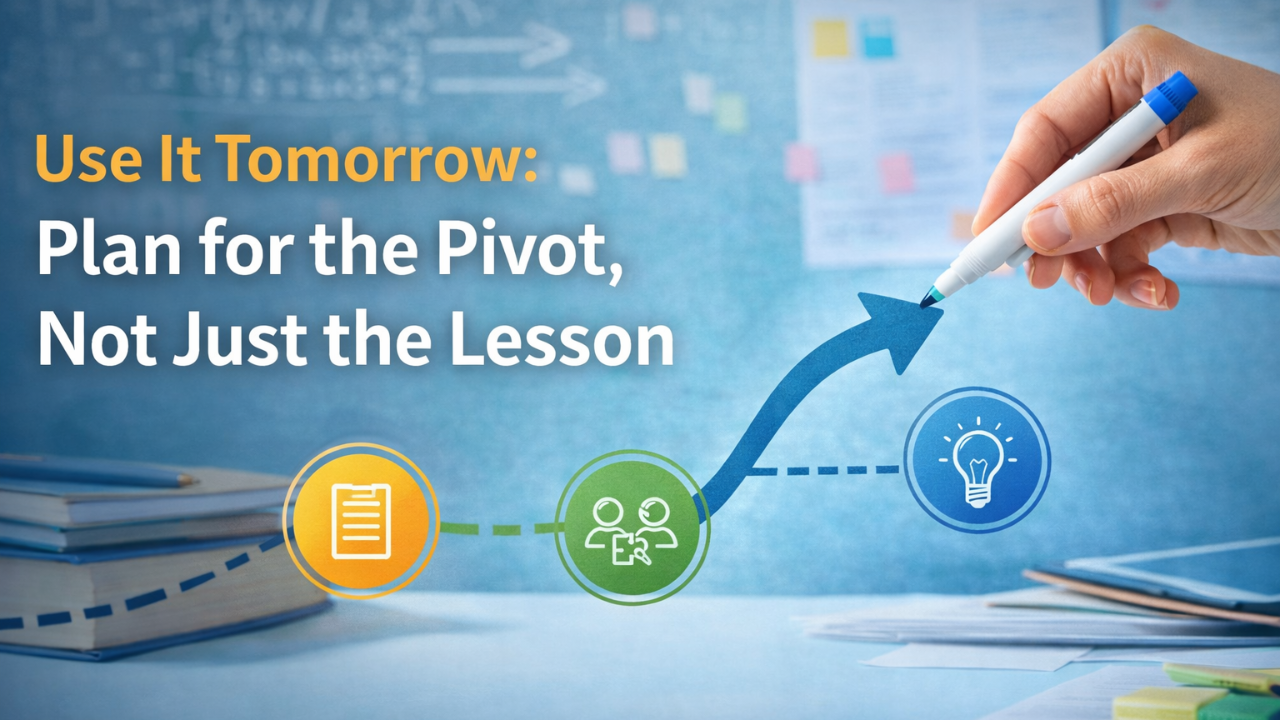
One of the most common frustrations teachers experience isn’t a lack of planning—it’s what happens when the plan meets reality.
You design a strong lesson. The task is aligned. The pacing makes sense. And then students begin working, and almost immediately, the room splits: some students are stuck before they begin, others finish quickly and wait, and a few are right where you expected them to be. At that moment, the question is no longer “Is this a good lesson?” It becomes “What do my learners need right now?”
This is the space where Design Area IV lives. As mentioned in the previous entry, “The elements in this design area operate in the space where instruction becomes responsive.” Or, in other words, we leverage the elements in this design area to react and respond to the real-time needs of the learners, which can, at times, mean pivoting from the plan you have in place.
But here’s the tension: you can’t effectively pivot in the moment if you didn’t plan to pivot ahead of time.
Start with a Simple Shift: Plan the Pathway, Not Just the Task
Most traditional lesson planning stops at the task, answering the question:
- What are students going to do to learn this content?
Responsive instruction requires one more layer:
- What will I do if students are at different points when they engage with this task?
In order to effectively prepare for the variety of responses students may need, it is essential to shift the focus from planning a single experience, to planning a pathway with options.
Here is a simple place to start. Take any lesson aligned to a Level 3.0 target. Before you teach it, ask yourself three questions:
- If students are not yet ready for this task, what support will I provide?
- More modeling, chunking, guided examples
- If students are close, but not quite there, how will I help them refine their thinking?
- Discussion, error analysis, comparison, reflection
- If students are ready, how will I extend their thinking?
- Application, transfer, increased complexity
You’re not creating three separate lessons. You’re building on-ramps and extensions to the same learning goal.
That’s what makes the pivot possible.
Then, Use Evidence to Choose the Path
At this point, you have planned your outcomes and put pathways in place to allow for pivoting. As students begin working, your role shifts from planner to decision-maker. This doesn’t require a new system. It requires a tighter loop:
Task → Evidence → Pattern → Response
As students engage, the teacher focus should be on gathering unobtrusive evidence which might take the form of:
- Listening to their thinking
- Scanning their work
- Noticing where the majority are struggling, progressing, or ready to extend
The key is to look for patterns, not perfection.
You’re not asking:
- Who got it right?
You’re asking:
- What does the evidence suggest this student needs next?
That pattern is what tells you which pathway to activate.
Keep the Decision Rule Simple
In the moment, complexity is the enemy. You need a decision rule you can run quickly.
A simple structure works:
- If students are struggling with foundational knowledge → increase structure with directed study
- If students are approaching proficiency → increase processing and reflection, minimize direct support through guided study
- If students demonstrate readiness → increase independence and complexity, remove direct support and enter into independent study.
That’s it.
You’re not changing the goal. You’re adjusting the support to pivot based on evidence.
Over time, this becomes less of a conscious decision and more of a habit of practice—one where instruction responds to learners instead of staying locked to the plan.
What This Looks Like Tomorrow
You don’t need to redesign everything to begin.
Try this in your next lesson:
- Identify your Level 3.0 target
- Plan your core task as you normally would
- Add:
- One scaffolded support option - directed study
- One processing/reflection move - guided study
- One extension opportunity - independent study
- During the lesson, pause and ask:
What pattern am I seeing? - Use that pattern to decide which move to make next
That’s the pivot.
Why This Matters
When this structure is in place, a few important things happen:
- Students who need support get it before frustration builds
- Students who are ready to think more deeply are not held back
- Engagement increases because the level of challenge stays appropriate
Most importantly, instruction becomes what it was always meant to be:
a response to learners, not a script to follow.
Final Thought
Planning matters. But in a responsive classroom, the goal of planning is not to predict exactly how the lesson will go.
It’s to ensure that when it doesn’t, you already know what to do next.
If you would like to deepen your understanding of Engaging Learners in Cognitively Complex Tasks or Generating and Defending Claims within the Marzano Academies Instructional Model, explore one of the Learning Hub’s Badging Experiences or subscribe to the Learning Lab for access to the Instructional Impact Guides, research folios, and a community of educators working to strengthen competency-based practice. You might also want to take one of our Coaching Sessions and have a Marzano Academies faculty member work directly with you and your team on implementing the Marzano Academies’ instructional model in your school.