
From Evidence to Action: Responding to Learners in Real Time
Apr 16, 2026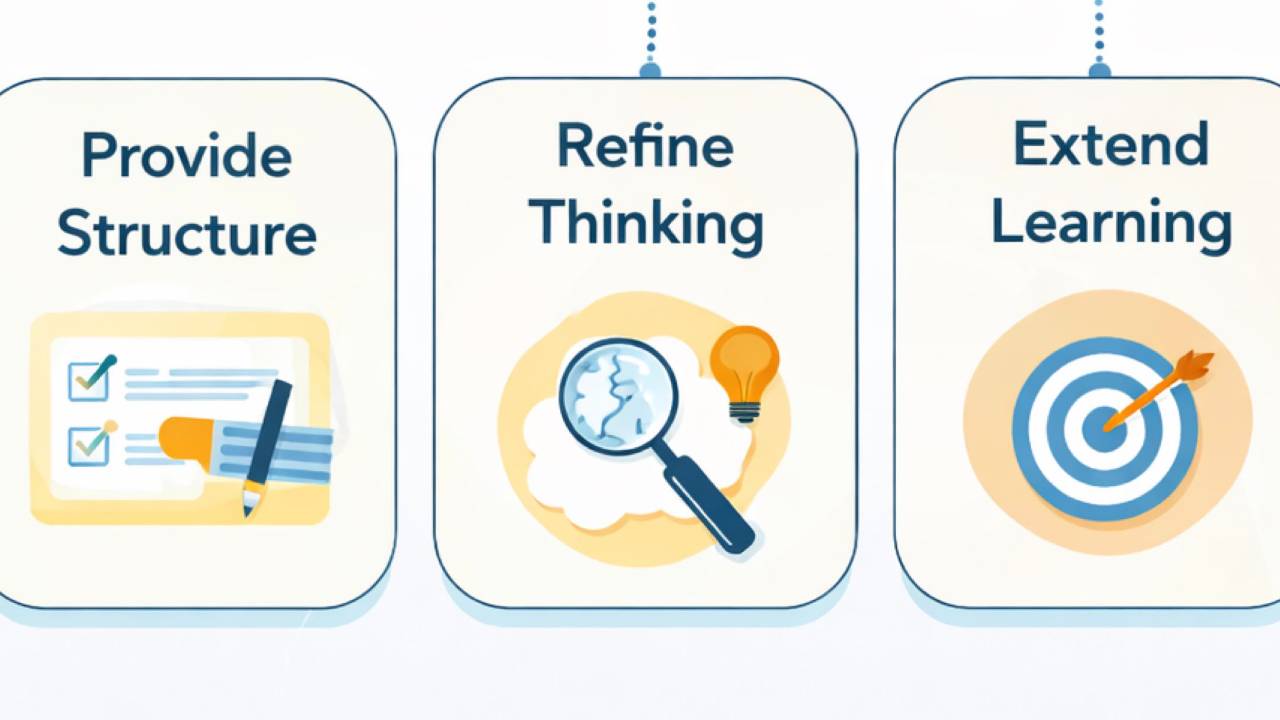
From Evidence to Action: Responding to Learners in Real Time
As we saw in the blogs for Design Area III, the focus is clear: ensure that students acquire and process new content through deliberate, cognitively grounded experiences. Teachers chunk content, guide processing, and ask students to record and represent their thinking. When this is done well, learning is not left to chance. Students build the foundational knowledge necessary for deeper thinking.
However, once that evidence begins to emerge through student responses, artifacts of thought, and observable behaviors, a new question surfaces: What do we do with the evidence we have captured about our learners? Design Area IV – General Instruction of the Marzano Academies Instructional Model provides the answer. The elements in this design area operate in the space where instruction becomes responsive. It is where teachers move from delivering learning experiences to adapting those experiences based on that evidence. In many ways, Design Area IV represents the difference between teaching a script and adapting the execution of your plan to learners’ needs.
Instruction as a Responsive System
At its core, Design Area IV is grounded in a simple but powerful idea: Instruction must respond to the learner, not the lesson plan. This principle is strongly supported in the research literature. Black and Wiliam (1998) describe formative assessment as a process in which evidence of learning is used to adapt teaching to meet student needs. Hattie (2012) reinforces this, noting that one of the most powerful influences on achievement is teachers’ ability to see learning through the eyes of their students and respond accordingly.
This shifts the role of the teacher. The teacher is no longer simply delivering content but is instead continuously asking who needs more direct support, who is ready to reflect and refine, and who is prepared to extend and apply their learning. Design Area IV makes this thinking actionable, supporting the learner with what they need to move forward along the learning continuum.
Theoretical Foundations: Why Adaptation Matters
The importance of adaptively executing your instruction plan is well established across several strands of research.
Cognitive Load Theory reminds us that learners have limited working memory capacity. When students struggle, it is often not due to lack of effort, but because the task exceeds their cognitive capacity. In these moments, additional structure, modeling, or chunking is required (Sweller, 1988). To simply continue moving along with the lesson plan will ensure some students progress without the critical mass of knowledge necessary to demonstrate understanding of the concept or execution of the skill at Level 3.0
Zone of Proximal Development further clarifies that learning occurs when tasks are just beyond a learner’s independent ability but achievable with support. Design Area IV lives in this space. It requires teachers to continually adjust support so that each learner remains within an optimal zone for growth (Vygotsky, 1978).
Willingham (2009) adds another layer, noting that memory is the residue of thought. If students are not thinking at the appropriate level, either because tasks are too easy or too difficult, learning will not occur. Responsive instruction ensures that thinking and the struggle that produces it remain productive.
From Teacher-Directed to Student-Led
One of the most important functions of Design Area IV is to help move learners along the continuum from teacher-directed instruction to student-led discovery. While Design Area III can help us plan for how to deliver the content and move the learners in the progression, Design Area IV allows us to use the evidence from our classroom assessments to adjust our instruction so all learners continue on the learning progression.
This progression, however, is not automatic. It must be intentionally managed. Some learners may require additional teacher-directed instruction. They need more modeling, more directed practice, and more opportunities to acquire and encode the foundational knowledge. Others are ready for reflection and consolidation. They benefit from opportunities to analyze their thinking, make connections, and refine their understanding. Still others are prepared to extend their learning. They are ready for cognitively complex tasks that require application, problem-solving, and independent thinking.
Kirschner, Sweller, and Clark (2006) caution against prematurely moving students into minimally guided discovery. Without sufficient background knowledge or plans to build it, such approaches can overwhelm learners and lead to misconceptions. Design Area IV ensures that movement toward independence is earned through evidence, not assumed by attendance.
The Role of Evidence in Instructional Decision Making
Design Area IV is inseparable from evidence. The tasks you plan using the elements of Design Area III and the artifacts learners generate as a result of those tasks provide a continuous stream of information about where they are in the learning progression. This aligns closely with CBE’s emphasis on evidence scores as indicators of current understanding. The critical shift is this: Evidence is not collected to evaluate learning. It is collected to guide instruction.
When teachers act on evidence, several important things are possible. They can address misconceptions before they become entrenched, instruction is differentiated in meaningful ways, students experience success at an appropriate level of challenge, and learning becomes more efficient and more effective, making it more enjoyable for the educator and the learner.
General Instruction as Strategic Adjustment
The elements within Design Area IV represent a repertoire of instructional moves that allow teachers to respond strategically to learner needs. These moves are not random. They are grounded in a decision-making process:
- If students are not yet demonstrating foundational understanding, increase structure and support in a directed study session
- If students are approaching proficiency, provide opportunities for deeper processing and reflection in a guided study session.
- If students demonstrate readiness, extend learning into application and transfer in an independent study task.
This aligns with Tomlinson’s (2014) work on differentiation, which emphasizes adjusting content, process, and product based on readiness. To assist differentiation within the Marzano Academies model, this adjustment is tightly anchored to proficiency scales and observable evidence.
Maintaining Cognitive Engagement Across Learners
A central risk in any classroom is uneven engagement. When instruction is not responsive, some students disengage because tasks are too difficult, while others disengage because tasks are too easy. Boredom with a task because it is seen as too easy is more dangerous to the learner's mindset than feeling overchallenged. Design Area IV mitigates this risk by ensuring that all learners remain cognitively engaged at an appropriate level. Optimal engagement occurs when challenge and skill are balanced.
It is important to note that Design Area IV is not a collection of isolated strategies. It is a system of responsive instruction built on three essential conditions: clear learning progressions (proficiency scales), ongoing evidence of student understanding, and a repertoire of instructional responses. Without these conditions, adaptation becomes guesswork instead of being intentional and precise.
Conclusion
Design Area IV represents a critical shift in instructional thinking. It moves teaching from delivering the content to responding to your learners, in other words, making decisions about what learners need instead of simply following your script. In essence, it answers the question: now that I know where my students are, what will I do next? When teachers consistently respond to evidence generated by learners while engaged in appropriate tasks, they ensure that all learners continue to progress from initial exposure, through structured understanding, and ultimately toward independent, student-led discovery.
To continue building your understanding of cognitively complex tasks and generating and defending claims, you may want to explore the Learning Hub’s Badging Experiences for Design Area IV or subscribe to the Learning Lab for access to professional development resources, including Dr. Marzano’s research folios for each element and a community of educators working to make their classrooms centered on competency-based practices. These resources are designed to help you identify a meaningful professional growth goal and develop a clear plan for strengthening your practice. As we often say, teachers should own their professional learning.
In Next week’s Use-It-Tomorrow blog, we will share additional strategies to support the principles of engaging learners in cognitively complex tasks and generating and defending claims.