
Rules and Procedures That Create Freedom to Learn
Jul 16, 2026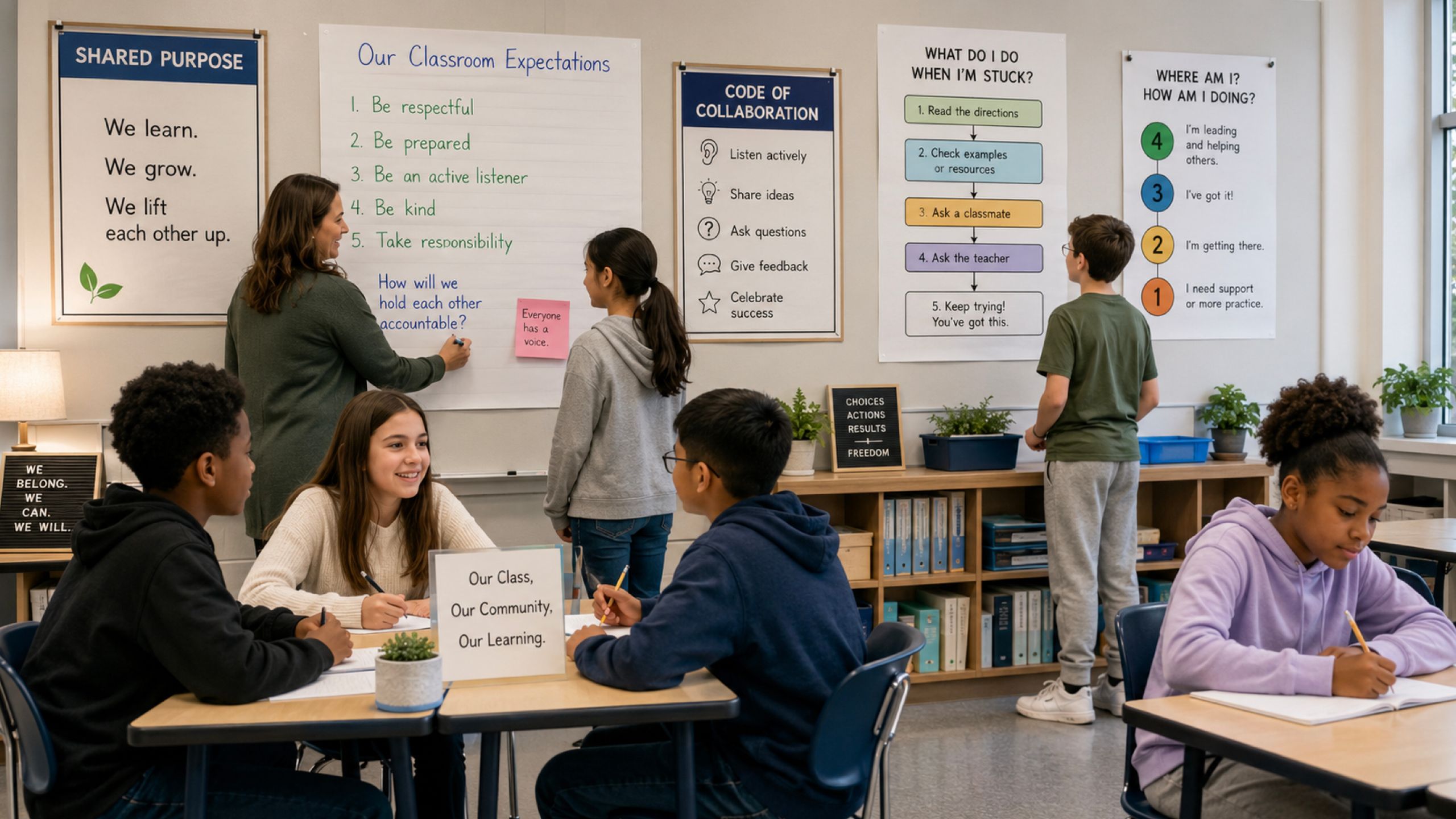
Most teachers know what it feels like when the classroom is technically functioning but still not working as well as it should. Students may be busy, but too much of the teacher’s energy is spent answering procedural questions, redirecting avoidable behavior, or clarifying expectations that should already be clear. One student asks what to do next. Another interrupts to ask whether they may move to a different space. A group starts talking loudly because no one is quite sure what collaboration should sound like. The teacher feels pulled in every direction.
In moments like these, the problem is not always motivation, content, or lesson design. Sometimes the problem is that the classroom community has not yet developed clear enough rules and procedures for students to operate with confidence and responsibility. In the Marzano Academies CBE Instructional Model, Elements VIIc, VIId, and VIIe can be grouped together as “Rules and Procedures.” These elements are:
- VIIc: Acknowledging adherence to rules and procedures
- VIId: Acknowledging lack of adherence to rules and procedures
- VIIe: Establishing and adapting rules and procedures
Together, these elements address a central question for competency-based classrooms: “How do we create enough shared structure that students can act with greater independence?”
That question is important because a CBE classroom asks more of students than a traditional classroom often does. Learners may be working on different measurement topics, using different resources, moving between groups, gathering evidence of learning, seeking feedback, reflecting on progress, and making decisions about next steps. Without clear rules and procedures, that level of flexibility can quickly dissolve into confusion. But when rules and procedures are well established, they do not limit agency. They make agency possible. But recognize, rules and procedures should not function as the teacher’s hidden demands. They should function as public agreements, visible routines, and shared tools that help the classroom community do its work.
Why: Students Need Clarity Before They Can Take Responsibility
Rules and procedures are sometimes misunderstood as compliance tools. In that view, the teacher makes the rules, students follow them, and consequences are applied when they do not. There is some truth in that, but it is incomplete. In a healthy CBE classroom, rules and procedures are not merely about control. They are about clarity, safety, responsibility, and access. Students cannot take ownership of their learning if they are constantly guessing what the teacher wants, what the next step is, how to use the room, how to get help, how to work with peers, or what happens when they do not meet expectations.
This is why rules and procedures are critically important. They make the classroom predictable enough for students to act independently. Marzano’s work on Design Area VII places rules and procedures inside the larger context of comfort, safety, and order. This matters because students are more likely to learn when they experience the classroom as safe, fair, and understandable. In the Marzano Academies model, teachers are expected not only to establish rules and procedures, but also to acknowledge when students follow them, acknowledge when students do not follow them, and adapt those rules and procedures with student input when needed (Marzano, 2021a, 2021b, 2021c).
Recent research supports this emphasis. Korpershoek, de Boer, and Mouw’s (2025) updated meta-analysis found that classroom management interventions have small but significant positive effects on students’ academic, behavioral, social-emotional, and motivational outcomes. Their review also notes a shift in classroom management research away from simple compliance and toward student self-direction, self-regulation, and teacher-student relationships. This distinction is important. The issue is not whether classrooms need management. They do. The issue is what kind of management best supports learning.
Patall and colleagues’ (2024) meta-analysis on classroom structure also reinforces this point. They define structure as teacher practices that guide student behavior and increase academic success. These practices include clear expectations, rules, routines, schedules, organized materials, monitoring, encouragement, and feedback. Their synthesis found that classroom structure is positively associated with engagement, achievement, and competence beliefs. However, they also caution that structure should be delivered in ways that support autonomy, relatedness, and positive emotion rather than in ways that feel controlling.
That is the balance teachers need. Students need structure, but they also need voice. They need boundaries, but also to understand the purpose of those boundaries. They need adult guidance, but not in a way that makes the classroom feel like a list of unknown demands.
This is where the teacher’s role is essential. Students should help shape the classroom community, but they should not be expected to create all rules and procedures on their own. The teacher is part of the classroom community and has a responsibility to protect the learning rights, safety, and dignity of every student. In Vygotsky’s language, the teacher functions as a more knowledgeable other, providing guidance, structure, and support so learners can participate in more complex forms of thinking and action than they could manage independently (Vygotsky, 1978). That does not diminish student voice. It gives student voice a productive structure.
When learners help build classroom rules and procedures, they are more likely to understand the reasons behind them. They are also more likely to view expectations as shared commitments rather than arbitrary commands. Recent student voice research supports this general principle. Conner, Mitra, Holquist, Rosado, Wilson, and Wright (2024) describe classroom student voice practices as involving relationships, differentiation, and choice. Conner, Mitra, Holquist, and Boat (2025) further examine how teachers’ student voice practices relate to engagement and achievement, emphasizing the importance of seeking student input and responding to it meaningfully.
This is the deeper reason to involve students in rules and procedures: not because students should decide everything, but because students need to understand and participate in the community they are being asked to help sustain.
How: Establish, Acknowledge, Correct, Adapt
The work of rules and procedures is not a one-time beginning-of-year activity. It is an ongoing instructional practice. Elements VIIc, VIId, and VIIe work together as a cycle: establish the expectations, acknowledge when students meet them, respond when they do not, and adapt the system when it is not working.
The first move is to establish rules and procedures with students when appropriate. This begins with shared purpose and is then converted into a Code of Collaboration.
A classroom community should be able to answer a basic question: Why are we gathered as a group? In a CBE classroom, the answer is not simply “to complete assignments” or “to get through the curriculum.” The purpose is to help every learner make progress toward meaningful learning goals while developing the habits, skills, and dispositions needed to act responsibly within a community.
Once that purpose is clear, the class can develop a code of collaboration. A code of collaboration should identify the attitudes and behaviors that make the shared purpose possible. For example, students might identify respect, responsibility, persistence, helpfulness, or honesty as attitudes that matter. The teacher then helps students translate those broad attitudes into visible behaviors. This step is crucial because attitudes are difficult to monitor directly. Behaviors become the evidence.
For example, “respect” might become:
- Listen when someone else is speaking.
- Use language that helps rather than harms.
- Disagree with ideas without attacking people.
- Return shared materials in good condition.
The teacher’s role is not passive. The teacher helps students clarify vague language, remove unrealistic expectations, add missing protections, and identify non-negotiables. A teacher might say, “I agree that we should have a voice in how we work together. I also need to make sure every student’s right to learn is protected.” That sentence captures the balance well. Students participate in creating the community, but the teacher remains responsible for ensuring the community is safe, fair, and academically focused.
Marzano’s work on VIIe explicitly supports this balance. Students should provide input into rules and procedures and feedback about how they are working throughout the year, while teachers also retain responsibility for non-negotiable rules that protect students’ rights to learn and the teacher’s ability to teach (Marzano, 2021c).
The second move is to turn expectations into procedures. We recommend the establishment of standard operating procedures, or SOPs. Rules tell students what matters. Procedures tell students how to live by those rules in real situations. This distinction is especially important in CBE classrooms. A rule might say, “Use learning time responsibly.” But students also need procedures for what to do when they finish early, get stuck, need feedback, want to move to another learning space, are ready to show evidence, or need help from a peer.
In the Marzano Academies model, these procedures are often articulated as standard operating procedures, or SOPs. An SOP can be a procedural list when the steps are sequential and clear, or it can be a flowchart when students need to make a decision. For example, “What do I do when I am stuck?” might work better as a flowchart because there are multiple possible pathways: check the proficiency scale, review notes, ask a teammate, use a resource, try a sample problem, or request a conference.
This matters because SOPs reduce unnecessary dependence on the teacher. They do not remove the teacher from the learning process. They free the teacher to provide more meaningful instruction, feedback, and support because students can handle routine decisions more independently.
The third move is to acknowledge adherence. Element VIIc reminds us that teachers should notice and recognize when students follow rules and procedures. This sounds simple, but it is easy to overlook. Teachers often respond quickly when students violate expectations but say little when students meet them. Over time, that can create a classroom culture where students mainly experience teacher attention as correction.
Acknowledging adherence helps reverse that pattern. This does not have to be elaborate. Acknowledgment can be verbal, nonverbal, private, public, individual, or group-based. The most important feature is that the teacher connects the acknowledgment to the expectation. Instead of saying only, “Nice job,” the teacher might say, “I noticed your group used the SOP before asking me for help. That kept the work moving.” Or, “Thank you for disagreeing with evidence instead of making it personal. That is exactly what our code of collaboration asks us to do.” Acknowledgment helps students see that rules and procedures are not just posted on the wall. They are active parts of the classroom community.
The fourth move is to acknowledge a lack of adherence in ways that teach responsibility. Element VIId is the corrective side of the system. When students do not follow rules and procedures, teachers must respond. Ignoring the lack of adherence communicates that expectations are optional. However, correction should be calm, fair, and connected to the behavior.
Marzano’s folio emphasizes verbal cues, nonverbal cues, pauses, time-outs, overcorrection, home contingencies, high-intensity situational plans, and overall discipline plans as strategies for responding to lack of adherence (Marzano, 2021b). The important point is not that every teacher uses every strategy. The point is that correction should be planned, consistent, and proportional.
Correction should also preserve dignity. In many cases, especially in a CBE classroom, teachers have opportunities to address behavior privately. This matters because public power struggles rarely build responsibility. They often create embarrassment, resistance, or resentment. A private redirection can communicate the same expectation while protecting the student’s place in the community.
Restorative-practice research reinforces the importance of relationships and repair. Moran and colleagues’ (2024) systematic review of teachers’ experiences with restorative practices found that relationships are foundational to restorative implementation and that restorative practices aim to build relationships, prosocial skills, behavior guidance, and conflict resolution. This fits well with the goal of VIId when used wisely. The purpose of correction is not simply to stop a behavior. The purpose is to help the learner return to the community in a better way.
The fifth move is to adapt rules and procedures. A rule or procedure that made sense in September may not work in November. A routine that works for one class may not work for another. A procedure that was clear to adults may not be clear to students. A CBE classroom is dynamic, and the rules and procedures must be dynamic as well.
This is why VIIe includes both establishing and adapting. Teachers should revisit rules and procedures with students. They might ask:
- What procedure is helping us learn?
- What procedure is slowing us down?
- Where are we still depending on the teacher too much?
- Which part of our code of collaboration needs more clarity?
- What should we adjust so the classroom works better for everyone?
This review process teaches students that rules and procedures are not arbitrary. They exist to serve the shared purpose of the classroom. If they are not serving that purpose, they can be improved.
This is also where proficiency scales can be useful for behavior goals. If a class identifies a specific behavior for an attitude, they can generate a scale to teach the procedural knowledge necessary to execute the proper behavior. Fror example, if I want my learners to develop an attitude of respect, behaviors such as “using kind words” or “working responsibly with a team,” can help students define what that behavior looks like at different levels. At the 2.0 level, students might learn the vocabulary and basic steps to a strategy they can call on to be respectful. At the 3.0 level, students demonstrate the behavior independently in familiar classroom situations. At the 4.0 level, students demonstrate the behavior under more challenging conditions or help others do the same.
This approach turns behavior expectations into learnable skills. It also gives students a tool for self-reflection and self-assessment. Instead of simply being told whether they were “good” or “bad,” students can ask, “Where am I on this behavior goal, what evidence do I have, and what is my next step?” That is a much stronger foundation for agency.
What: What It Looks Like When Rules and Procedures Are Working
When rules and procedures are working, the classroom feels clear without feeling controlled. Students know the shared purpose of the classroom. They can describe the code of collaboration and explain why it matters. They understand that the teacher is not simply enforcing personal preferences but helping the class live up to agreements that protect learning, safety, and dignity.
Students also know what to do in common situations. They do not need to ask the teacher every time they are stuck, finished, confused about materials, ready for feedback, or unsure how to transition. They can use SOPs, posted procedures, peer supports, proficiency scales, and monitoring tools to make productive decisions.
When adherence is acknowledged well, students recognize that positive behavior is visible. They know the teacher notices when they use routines responsibly, treat classmates well, follow procedures, or help the classroom run smoothly. The acknowledgment is not empty praise. It is feedback that names the behavior and reinforces the community’s shared expectations.
When lack of adherence is acknowledged well, students experience correction as fair and predictable. They may not enjoy being corrected, but they understand the reason for it. They can describe the teacher as consistent. They can connect the consequence to the behavior. They do not feel that expectations shift depending on the teacher’s mood or the student’s identity.
When rules and procedures are adapted well, students have a voice in improving the classroom. They can say, “This procedure is not working,” and expect the class to examine it. They can help revise an SOP, clarify a norm, or strengthen a routine. They are not passive recipients of the teacher’s system. They are members of the community, learning how systems work and how responsible people improve them.
This is particularly important in competency-based classrooms. CBE depends on students gradually taking more responsibility for their learning. But responsibility does not develop through slogans. It develops through repeated opportunities to make decisions inside clear structures, experience the consequences of those decisions, reflect, and adjust.
Rules and procedures create the structure for that kind of practice.
The desired effect is not mere compliance. The desired effect is responsible independence.
Bringing the Three Elements Together
Elements VIIc, VIId, and VIIe are best understood as a system for building a classroom community where expectations are clear, visible, shared, and teachable. Together, they help teachers move from hidden demands to public commitments.
This matters because students should not have to guess what kind of classroom they are in. They should not have to infer the rules from the teacher’s frustration. They should not have to wait until they make a mistake to discover a procedure. And they should not experience classroom management as something done to them rather than something built with them.
At the same time, student voice does not mean the teacher steps away from leadership. The teacher remains a responsible member of the classroom community with an important role to play. Teachers bring professional knowledge, developmental understanding, instructional goals, and a duty to protect every learner’s right to learn. They know which expectations are non-negotiable. They know where safety, dignity, and academic integrity cannot be compromised.
The strongest classroom communities hold both truths together: students should help shape the rules and procedures that govern the community, and teachers should guide that process with wisdom, clarity, and care. When rules and procedures work this way, they become more than management. They become part of the learning design.
In a competency-based classroom, that is the point. We are not simply trying to get students to follow directions. We are helping them become learners who understand expectations, make responsible decisions, reflect on their actions, and contribute to the conditions that allow everyone to learn. Rules and procedures are not the opposite of agency. When developed well, they are one of the ways agency becomes possible.
To continue building understanding of Design Area VII and the full Marzano Academies instructional model, educators can explore the Learning Hub. Members can access Dr. Marzano’s research folios, professional learning resources, and practical tools designed to help teachers make competency-based practices work in real classrooms. The Learning Hub also includes Badging Experiences that allow teachers to identify a meaningful professional growth goal, strengthen classroom routines, and document their growing expertise. Teachers should own their professional learning, and the Learning Hub is built to support that work.
References
Conner, J., Mitra, D., Holquist, S., & Boat, A. (2025). How teachers’ student voice practices affect student engagement and achievement: Exploring choice, receptivity, and responsiveness to student voice as moderators. Journal of Educational Change, 26, 89–118. doi:10.1007/s10833-024-09513-0
Conner, J., Mitra, D. L., Holquist, S. E., Rosado, E., Wilson, C., & Wright, N. L. (2024). The pedagogical foundations of student voice practices: The role of relationships, differentiation, and choice in supporting student voice practices in high school classrooms. Teaching and Teacher Education, 142, 104540. doi:10.1016/j.tate.2024.104540
Korpershoek, H., de Boer, H., & Mouw, J. M. (2025). An update of the meta-analysis of the effects of classroom management interventions on students’ academic, behavioral, social-emotional, and motivational outcomes. Review of Educational Research. doi:10.3102/00346543251361903
Mammadov, S., & Schroeder, K. (2023). A meta-analytic review of the relationships between autonomy support and positive learning outcomes. Contemporary Educational Psychology, 75, 102235. doi:10.1016/j.cedpsych.2023.102235
Marzano Academies. (2018). Marzano Academies instruction manual. Marzano Academies.
Marzano, R. J. (2021a). Element VIIc: Acknowledging adherence to rules and procedures in a CBE classroom. Marzano Academies.
Marzano, R. J. (2021b). Element VIId: Acknowledging lack of adherence to rules and procedures in a CBE classroom. Marzano Academies.
Marzano, R. J. (2021c). Element VIIe: Establishing rules and procedures in a CBE classroom. Marzano Academies.
Marzano, R. J., & Abbott, S. D. (2022). Teaching in a competency-based elementary school: The Marzano Academies model. Marzano Resources.
Marzano, R. J., Aschoff, A. S., & Avila, A. (2022). Teaching in a competency-based secondary school: The Marzano Academies model. Marzano Resources.
Marzano, R. J., Norford, J. S., Finn, M., & Finn, D., III. (2017). A handbook for personalized competency-based education. Marzano Resources.
Moran, E., Kourkoutas, E., & Cooper, P. (2024). Exploring restorative practices: Teachers’ experiences with early adolescents. International Journal of Educational Research Open, 6, 100312. doi:10.1016/j.ijedro.2024.100312
Patall, E. A., Yates, N., Lee, J., Chen, M., Bhat, B. H., Lee, K., Beretvas, S. N., Lin, S., Yang, S. M., Jacobson, N. G., Harris, E., & Hanson, D. J. (2024). A meta-analysis of teachers’ provision of structure in the classroom and students’ academic competence beliefs, engagement, and achievement. Educational Psychologist, 59(1), 42–70. doi:10.1080/00461520.2023.2274104
Vygotsky, L. S. (1978). Mind in society: The development of higher psychological processes. Harvard University Press.