Why Cognitively Complex Tasks Matter
Apr 03, 2026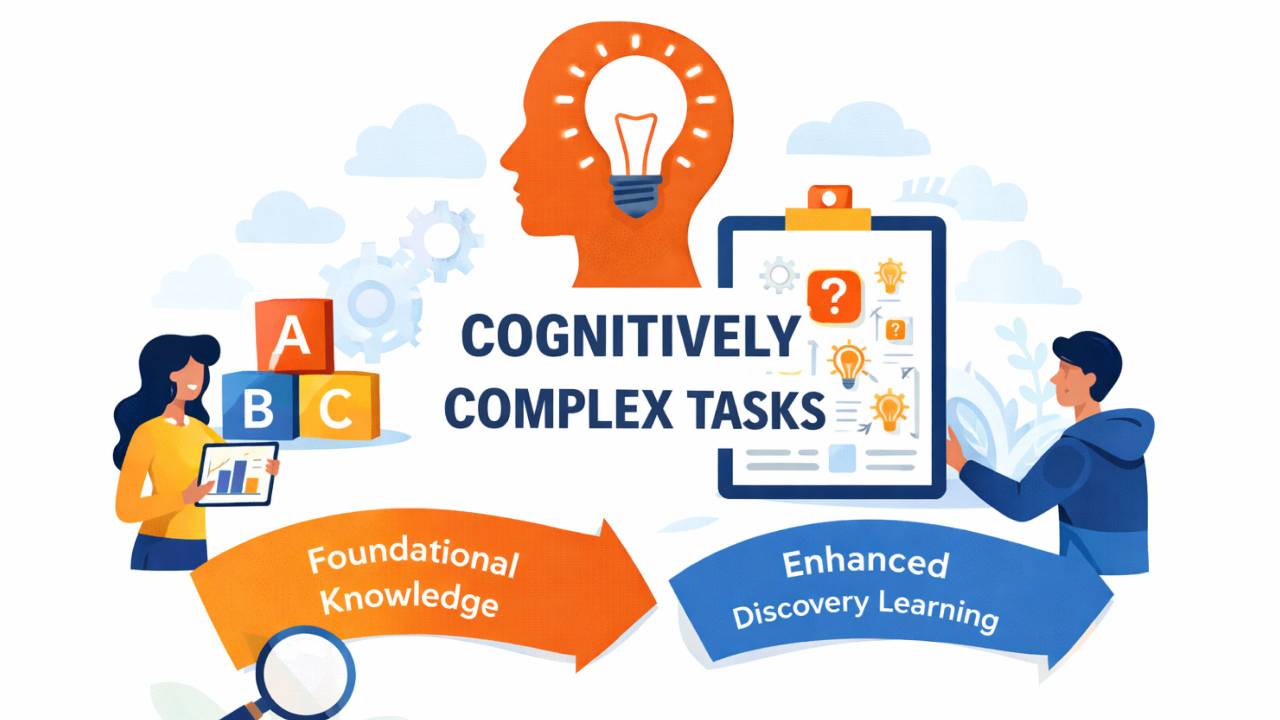
In the first phase of Design Area III, we focused on helping learners acquire and encode foundational knowledge through chunking, processing, and recording, the CPR that keeps cognitive engagement alive. Then we examined the next instructional decision: whether learners needed structured practice because the content was procedural, or whether they needed to examine similarities and differences because the content was declarative. Those earlier moves matter because cognitively complex tasks are not where learning begins. They are where learners begin to do something meaningful with what they know.
That sequence matters. Dr. Marzano describes cognitively complex tasks as tasks that require students to apply what they know in ways that are new to them, often over more than one class period, and through structures such as problem solving, decision making, experimental inquiry, investigation, invention, and systems analysis. The folio for IIIg – Generating and Defending Claims also makes clear that students should be able to generate and defend conclusions as part of that work.
Cognitive science gives us a strong reason to sequence the work this way. Learning is more durable and more transferable when new knowledge is connected to prior knowledge, organized into meaningful mental structures, and revisited in ways that move beyond short-term performance. Prior knowledge shapes what learners notice, how they interpret new information, and what they are able to do with it later. In other words, learners are far more prepared for complex application when foundational knowledge has already been encoded and organized.
Complex tasks are not an add-on. They are where knowledge becomes usable.
If we want students to do more than recall information, they must eventually use knowledge in situations that require judgment, transfer, adaptation, and explanation. That is the value of cognitively complex tasks. They press learners to apply knowledge in unfamiliar contexts, make decisions among alternatives, test hypotheses, analyze systems, investigate unresolved questions, and invent solutions. When learners do this, they are not merely retrieving information. They are reorganizing it, connecting it, and extending it. That is a major reason these tasks deepen understanding.
This aligns with broader research on deeper learning and transfer. Transfer does not arise automatically from coverage or repetition alone. It is strengthened when students understand underlying principles, use knowledge in varied contexts, and are asked to explain how and why ideas apply. Teaching that emphasizes not only what to know, but also when, how, and why to use that knowledge is more likely to produce flexible understanding.
But complex tasks are not the place to start.
This is where the conversation often gets muddied. It is tempting to hear the phrase student-led discovery and assume that learners should begin with open-ended exploration. The problem is that discovery learning without sufficient prior knowledge can overload working memory and produce confusion rather than insight (Kirschner, Sweller, and Clark, 2006). That is the major caution raised by research on minimal guidance. For novice learners, explicit guidance is often more effective and more efficient than asking them to discover foundational ideas on their own.
At the same time, the story does not end there. Inquiry, problem-based learning, and investigation can be powerful when they are scaffolded. Hmelo-Silver, Duncan, and Chinn (2007) make this point directly. The issue is not whether students should engage in complex inquiry. The issue is whether the inquiry is supported with enough structure, modeling, and guidance to make the work educative rather than overwhelming.
That is why enhanced discovery learning is so important. We do not mean unguided discovery. We mean a sequence that begins with teacher-directed support to help learners acquire and encode foundational knowledge, and then shifts toward student-led discovery once learners have enough knowledge to think productively. That is a much more defensible cognitive position. It respects what we know about novice learners while still honoring the importance of agency, inquiry, and application.
The sequence matters: CPR first, then the right kind of deepening, then complex application.
When learners have first experienced chunking, processing, and recording, they are more prepared to retrieve and organize foundational knowledge. When teachers then decide whether learners need structured practice for procedural knowledge or similarities and differences for declarative knowledge, they are helping students strengthen the very mental architecture needed for later application. Only then are many learners ready for cognitively complex tasks.
This is also why not every level of proficiency should be represented by a cognitively complex task. For a novice learner, proficiency can be a comprehensive understanding of a concept or a sound execution of a skill. That level of performance is not “less than.” It is often the necessary foundation for later units, where learners can apply, transfer, defend, and extend their learning in more cognitively demanding ways.
Research on productive failure helps clarify this point. Kapur’s (2014) work suggests that problem solving before direct instruction can deepen later conceptual understanding under certain conditions, but the boundary conditions matter. It is not a license for unstructured struggle. In fact, desirable difficulties are only desirable when learners have enough prior knowledge to respond successfully. Without that foundation, the difficulty becomes undesirable.
Why cognitively complex tasks deepen learning
Cognitively complex tasks matter because they require learners to do what memory researchers and learning scientists consistently associate with durable learning.
First, they require retrieval and reorganization. Retrieval strengthens memory and supports long-term retention (Bjork & Bjork, 2011). Learners must recall prior knowledge and then use it for a purpose. Second, they require connection making. Students must identify relationships among ideas, variables, criteria, causes, and consequences. This type of knowledge organization supports transfer and deeper understanding (National Research Council, 2000). Third, they require adaptation. The task is new to them, so they cannot simply mimic a prior example. Fourth, they require sense-making. Students must explain what they did, why they did it, and what conclusion is warranted by the evidence they gathered. Research on argumentation shows that constructing and defending claims strengthens reasoning and conceptual understanding (Kuhn & Udell, 2003). This is why generating and defending claims is such an important component of cognitively complex tasks. Students are not only reaching conclusions; they are supporting those conclusions with evidence and reasoning (Marzano, 2021).
That final point matters a great deal. In the folio for Element IIIg, generating and defending claims is presented not as a side activity, but as part of learning content more deeply. Students generate claims, provide grounds, offer backing, and describe qualifiers. They also explain why this process helps them learn more deeply and rigorously. Deanna Kuhn’s work shows that argument skill develops through repeated opportunities to make claims, consider counterarguments, and support positions with reasoning. (Kuhn & Udell, 2003). Argumentation is not just a communication skill. It is a thinking skill. When learners generate and defend claims, they clarify what they believe, test the strength of their reasoning, and refine their understanding in light of evidence.
What this means for classroom design
The practical implication is straightforward. We should not rush novice learners into open discovery and call it rigor. Nor should we stop at foundational learning and call it mastery. Strong design moves in a sequence. At the beginning, teachers are more directive. They help learners acquire, encode, and organize foundational knowledge. They model, guide, chunk, process, record, compare, classify, and structure practice. Then, as learners develop enough knowledge to think with, the classroom can shift. Students begin to solve problems, make decisions, investigate unresolved issues, test hypotheses, invent solutions, and analyze systems. They begin to generate and defend claims about what they have found.
That is a more cognitively coherent pathway from teacher-directed learning to student-led discovery.
Final thought
Cognitively complex tasks are valuable not because they feel engaging, modern, or ambitious. They are valuable because they ask learners to use knowledge in ways that build transfer, deepen understanding, and strengthen reasoning. But those benefits are most likely to appear when the task comes after learners have the foundation to succeed. So the goal is not discovery first. The goal is foundation first, then enhanced discovery. That is the move from acquiring knowledge to using it. From remembering to reasoning. From teacher direction to student ownership. And when learners generate and defend claims as part of that work, they are not just completing a task. They are learning to think.
To continue building your understanding of cognitively complex tasks and generating and defending claims, you may want to explore one of the Learning Hub’s Badging Experiences for Design Area III or subscribe to the Learning Lab for access to professional development resources, including Dr. Marzano’s research folios for each element and a community of educators working to make their classrooms centered on competency-based practices. These resources are designed to help you identify a meaningful professional growth goal and develop a clear plan for strengthening your practice. As we often say, teachers should own their professional learning.
In Next week’s Use-It-Tomorrow blog, we will share additional strategies to support the principles of engaging learners in cognitively complex tasks and generating and defending claims.
References
Bjork, E. L., & Bjork, R. A. (2011). Making things hard on yourself, but in a good way: Creating desirable difficulties to enhance learning. In M. A. Gernsbacher, R. W. Pew, L. M. Hough, & J. R. Pomerantz (Eds.), Psychology and the real world: Essays illustrating fundamental contributions to society (pp. 56–64). Worth Publishers.
Hmelo-Silver, C. E., Duncan, R. G., & Chinn, C. A. (2007). Scaffolding and achievement in problem based and inquiry learning: A response to Kirschner, Sweller, and Clark (2006). Educational Psychologist, 42(2), 99–107.
Kapur, M. (2014). Productive failure in learning math. Cognitive Science, 38(5), 1008–1022.
Kirschner, P. A., Sweller, J., & Clark, R. E. (2006). Why minimal guidance during instruction does not work: An analysis of the failure of constructivist, discovery, problem based, experiential, and inquiry based teaching. Educational Psychologist, 41(2), 75–86.
Kuhn, D., & Udell, W. (2003). The development of argument skills. Child Development, 74(5), 1245–1260.
National Research Council. (2000). How people learn: Brain, mind, experience, and school: Expanded edition. The National Academies Press.
National Research Council. (2012). A framework for K-12 science education: Practices, crosscutting concepts, and core ideas. The National Academies Press.
National Academies of Sciences, Engineering, and Medicine. (2018). Science and engineering for grades 6-12: Investigation and design at the center. The National Academies Press.
Marzano, R. J. (2021). Element IIIf: Engaging students in cognitively complex tasks in a competency-based classroom. Marzano Academies.
Marzano, R. J. (2021). Element IIIg: Generating and defending claims in a competency-based classroom. Marzano Academies.