The Decision Point: Procedural or Declarative? Why It Matters for Learning
Mar 19, 2026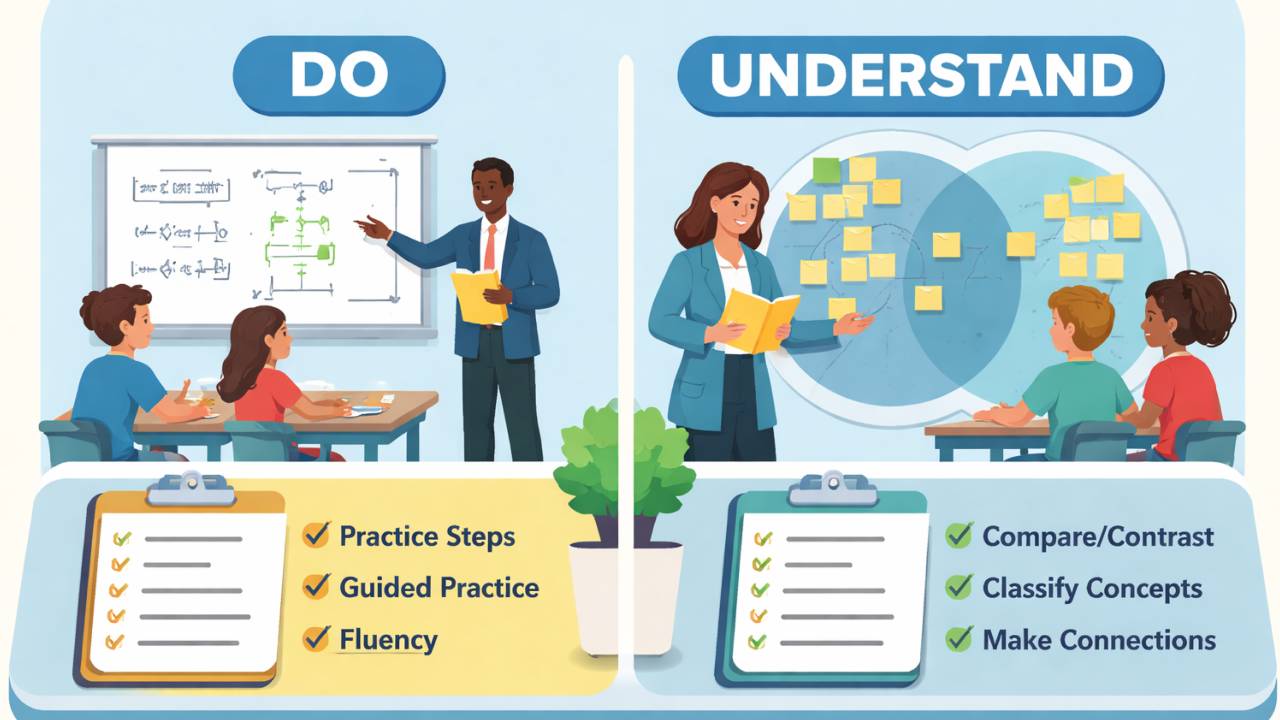
In the first three elements of the Design Area for Proficiency Scales Instruction, chunking, processing, and recording (CPR), students are building an initial understanding of new content. This helps them to encode and retrieve the foundational knowledge for the skill or concept you are teaching. To help them move beyond the retrieval of random knowledge and move towards building ability and understanding, a critical decision remains: What kind of knowledge are students working with? Is it something they must do, or something they must understand?
This distinction between procedural knowledge and declarative knowledge is not simply semantic. It determines what students need next to deepen their learning. When teachers misidentify the type of knowledge, they often select strategies that feel productive but do not move learning forward.
Why the Distinction Matters
Declarative knowledge refers to facts, concepts, and generalizations. Procedural knowledge refers to skills, strategies, and processes. At first glance, the distinction seems straightforward. But in practice, it is more nuanced.
It is also important to recognize that procedural knowledge begins as declarative knowledge. Before students can execute a skill, they must first understand it. They must know what the steps are, why they matter, and when to apply them. Cognitive science reinforces this progression. Anderson’s ACT-R theory describes learning as moving from a declarative stage (knowing about a process) to a procedural stage (performing it fluently) (Anderson, 1982). Similarly, Fitts and Posner (1967) describe skill development as moving from cognitive to associative to autonomous phases.
The implication is clear: All procedural knowledge has a declarative foundation. At the same time, not all declarative knowledge should become procedural. This is the decision teachers must make. If the learning goal is execution with accuracy and fluency, students need structured practice, Element IIId. If the goal is understanding relationships and meaning, students need to examine similarities and differences, Element IIIe.
When the Content Is Procedural: Use Structured Practice
When students are learning a skill, strategy, or process, they need opportunities to practice in a structured, intentional way. Structured practice is not simply “more practice.” It is designed practice. According to the folio for Element IIId, effective structured practice includes modeling, guided practice, close monitoring, and progression toward independent and fluent performance.
What this can look like in practice:
- Model the procedure clearly
- Provide step-by-step demonstrations
- Use worked examples to reduce cognitive load (Sweller, 1988)
- Guide initial attempts
- Move from simple to complex applications
- Provide immediate feedback to prevent error consolidation
- Monitor closely
- Intervene early when misconceptions appear
- Ensure accuracy before increasing complexity
- Design practice intentionally
- Use massed practice early, then shift to distributed practice over time
- Build toward fluency (accuracy + speed)
This aligns strongly with research on deliberate practice (Ericsson, 2006) and cognitive load theory (Sweller, 1988). Novices benefit from explicit guidance and structured rehearsal because their working memory is limited. As proficiency increases, practice becomes more independent and adaptive.
It is also advisable not to give the novice learners an unworked problem and ask them to figure it out on their own. When students generate procedures too early, they often build flawed approaches that feel right but are incomplete or incorrect. The challenge is that once these procedures are practiced, they begin to stick. As Robert and Elizabeth Bjork note, learning that becomes fluent and automatic is also more resistant to change. In other words, what students practice first matters because it is what they are most likely to retain (Bjork & Bjork, 2011).
This is why early modeling and guided practice are critical when developing procedural knowledge. If you choose to start with an unworked example, be clear about the purpose. Students are not solving it. They are analyzing it. Ask them to look for similarities and differences across examples and not solutions. This activates prior knowledge and prepares them to learn without reinforcing unproductive habits.
A Practical Example
If students are learning to solve multi-step equations:
- They first observe worked examples
- Then, complete partially solved problems
- Then correct errors
- Then solve independently
I call this the See it – Finish it – Fix it – Do it approach to building procedural knowledge with the novice learner.
When the Content Is Declarative: Examine Similarities and Differences
When students are learning concepts, categories, or relationships, they need to analyze how ideas connect. This is where examining similarities and differences becomes essential. As described in Element IIIe, comparing, classifying, and abstracting help students deepen their understanding and correct misconceptions. This is not a surface-level activity. It is a cognitive restructuring process.
Why It Works
Research consistently shows that identifying similarities and differences is one of the most powerful strategies for learning (Gentner & Markman, 1997; Richland et al., 2007). When students compare, they:
- Activate prior knowledge
- Identify critical attributes
- Refine mental models
- Transfer understanding to new contexts
At its core, learning involves the development and refinement of schemas, which are organized networks of knowledge stored in long-term memory. When a novice learner first encounters a four-legged, furry animal and is told it is a cat, they begin forming an initial schema. As they encounter new examples, such as mistakenly identifying a dog as a cat and then being corrected, they refine and differentiate that schema. Over time, through repeated exposure, comparison, and categorization, the learner develops more precise and interconnected schemas based on the critical attributes of each concept (Chi, 2008; Sweller et al., 2011).
This process of building and refining schemas is central to what learners are doing in classrooms. As knowledge becomes more organized, schemas allow learners to recognize patterns and respond more efficiently in familiar situations. In many cases, schemas function like cognitive “scripts,” guiding how learners interpret information and decide what actions to take (Anderson, 1996). When a relevant schema is activated, cognitive processing becomes more efficient because the learner is no longer relying solely on limited working memory.
However, when learners do not yet have an appropriate schema or cannot access one, tasks place greater demands on working memory. This can lead to confusion, frustration, or cognitive overload, particularly for novices. Effective instruction, therefore, supports learners in building accurate schemas and provides sufficient early guidance so that these schemas can form correctly and be applied successfully over time (Sweller, 1988; Kirschner, Sweller, & Clark, 2006).
What this can look like in practice:
- Comparing
- Use sentence stems or structured prompts
- Focus on meaningful characteristics, not trivial ones
- Classifying
- Group items based on shared attributes
- Move between superordinate and subordinate categories
- Abstracting
- Identify underlying patterns across contexts
- Use analogies and metaphors to deepen understanding
Graphic organizers such as Venn diagrams, T-charts, and comparison matrices support this work by making thinking visible. We strongly recommend the use of Knowledge Maps, which is School Level Indicator 8 in the Marzano Academies Model of CBE implementation. The maps can be accessed through our Learning Lab, part of the Learning Hub, a subscription-based service for educators who want to implement CBE practices in their classrooms.
A Practical Example
If students are learning forms of government:
- They compare democracy and republic based on core principles
- They classify systems based on power structures
- They abstract patterns about representation and authority
Memorization alone is not the goal. What matters is organizing knowledge into clear, usable schemas.
Bringing It Together: The Instructional Move That Changes Everything
After chunking, processing, and recording (CPR), teachers must ask: Do students need to get better at doing this, or better at understanding this? That single decision determines the next step. If procedural knowledge, then structured practice (Element IIId). If declarative knowledge, then Examining Similarities and Differences (Element IIIe). When this decision is made well, instruction becomes more precise, more efficient, and more impactful.
Final Thought
One of the most common instructional missteps is treating all learning the same. But learning is not uniform. It requires different approaches depending on the nature of the knowledge. Recognizing that procedural knowledge grows out of declarative understanding and then making intentional decisions about how to move learning forward, is what helps separate coverage from mastery.
To continue building your understanding of Structured Practice and Examining Similarities and Differences, you may want to explore one of the Learning Hub’s Badging Experiences or subscribe to the Learning Lab for access to professional development resources, including Dr. Marzano’s research folios for each element and a community of educators working to make their classrooms centered on competency-based practices. These resources are designed to help you identify a meaningful professional growth goal and develop a clear plan for strengthening your practice. As we often say, teachers should own their professional learning.
In Next week’s Use-It-Tomorrow blog, we will share additional strategies to support the principles of structured practice and similarities and differences in your classroom.
References:
Anderson, J. R. (1982). Acquisition of cognitive skill. Psychological Review, 89(4), 369–406.
Anderson, J. R. (1996). ACT: A simple theory of complex cognition. American Psychologist, 51(4), 355–365.
Bjork, R. A., & Bjork, E. L. (2011). Making things hard on yourself, but in a good way: Creating desirable difficulties to enhance learning. In M. A. Gernsbacher, R. W. Pew, L. M. Hough, & J. R. Pomerantz (Eds.), Psychology and the real world: Essays illustrating fundamental contributions to society (pp. 56–64). Worth Publishers.
Chi, M. T. H. (2008). Three types of conceptual change: Belief revision, mental model transformation, and categorical shift. In S. Vosniadou (Ed.), International handbook of research on conceptual change (pp. 61–82). Routledge
Ericsson, K. A. (2006). The influence of experience and deliberate practice on the development of superior expert performance. Cambridge Handbook of Expertise and Expert Performance.
Fitts, P. M., & Posner, M. I. (1967). Human Performance. Brooks/Cole.
Kirschner, P. A., Sweller, J., & Clark, R. E. (2006). Why minimal guidance during instruction does not work. Educational Psychologist, 41(2), 75–86.
Gentner, D., & Markman, A. B. (1997). Structure mapping in analogy and similarity. American Psychologist, 52(1), 45–56.
Richland, L. E., Zur, O., & Holyoak, K. J. (2007). Cognitive supports for analogies in the mathematics classroom. Science, 316(5828), 1128–1129.
Sweller, J. (1988). Cognitive load during problem solving: Effects on learning. Cognitive Science, 12(2), 257–285.
Sweller, J., Ayres, P., & Kalyuga, S. (2011). Cognitive load theory. Springer.
Marzano, R. J. (2011, 2012); Marzano Academies Folio Series