Not More—Better: Choosing the Right Next Step for Learning
Mar 27, 2026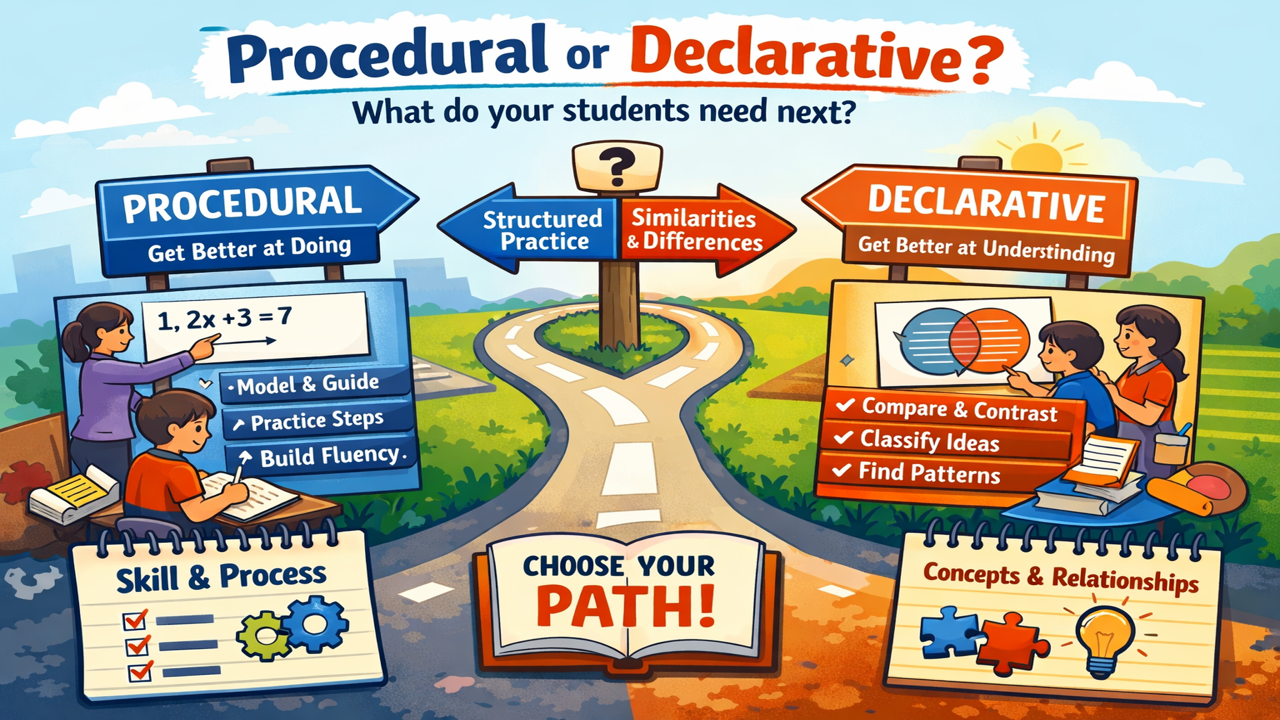
You’ve chunked the content.
You’ve had students process it.
They’ve recorded their thinking.
On paper, the lesson looks complete.
But in practice, this is the moment where learning either accelerates…or stalls.
Because after CPR, students don’t just need more.
They need something specific.
And the difference comes down to one decision: Do they need to get better at doing this, or better at understanding this?
Most of the time, we don’t pause long enough to answer that. We just move to “the next activity.” But that’s where things start to feel inefficient—students are working, but not necessarily progressing which can lead to burn-out and frustration both from students and teachers.
So, here’s a simple way to think about what to do tomorrow that can help teachers to better understand how to diagnose what comes next and streamline the process of planning saving precious time and alleviating some of the frustration mentioned earlier.
If Students Need to Do It Better
You’ll usually feel this pretty quickly. To clarify, here’s how this might look from a practical standpoint:
Students are attempting the work, but
- They’re inconsistent
- They’re skipping steps
- They’re getting answers, but not reliably
That’s your signal: this is procedural.
And when the need is procedural, the move is not to explain it again. The move is to tighten the practice.
Instead of handing students a new set of problems and hoping repetition fixes it, start by pulling everyone back together and showing a clean example of the process. Walk through it step-by-step. Say the thinking out loud. Make the invisible visible.
Then—and this is where the shift happens—don’t send them off independently just yet.
Have them stay in the process with you.
Maybe they finish part of the problem you started.
Maybe they look at a completed example and explain what’s happening.
Maybe they fix an error that you intentionally planted.
What you’re doing here is controlling the early reps.
Because those first reps matter more than we tend to think. If students practice it wrong, they don’t just make a mistake—they start building a version of the process that sticks.
So, as they begin trying it themselves, stay close.
Watch for patterns.
Pause the room if you see a common error.
Have students explain what they’re doing, not just produce an answer.
According to the structured practice Instructional Impact Guide, IIId, this phase—modeling, guided practice, and close monitoring—is where accuracy is built before independence is expected. Only after that do you widen the lane. think of it as a "See It - Finish It - Fix It - Do It" approach.
Students can begin working more independently. The problems can get a little more complex. Over time, you start spacing practice out so it’s not all happening in one sitting, but rather, revisited across days. That is the cognitive strategy known as distributed practice.
Eventually, what you’re aiming for is fluency—where students aren’t just getting it right, but doing so with confidence and efficiency.
But that only happens when the early practice is tight.
If Students Need to Understand It Better
Other times, the issue isn’t execution at all.
Students can complete the task… but:
- They can’t explain why
- They confuse it with something similar
- Their understanding falls apart in a new context
That’s your signal: this is declarative.
And this is where more practice won’t fix it.
What students need instead is to organize their thinking.
A simple way to start is by shifting the task slightly. Instead of asking for an answer, ask for a comparison.
Not: “What is this?”
But: “How is this similar to and different from something else we’ve learned?”
That one move forces students to stop relying on recall and start identifying what actually matters.
At first, you’ll probably need to support that thinking.
Give them a structure:
- “These are similar because…”
- “They are different because…”
Or have them sketch it out using something visual—a quick T-chart or Venn diagram works well. The goal isn’t the organizer itself. It’s making their thinking visible enough that it can be refined. We discussed strategies to support the 'R" or record as part of CPR.
From there, you can push a little further.
Ask them to group examples.
Then regroup them using a different characteristic.
Then explain why those groupings make sense.
What you’re really doing is helping them build categories and relationships—what the research describes as comparing, classifying, and abstracting- and this is where learning deepens.
Because once students start seeing patterns—what belongs together, what doesn’t, and why—they’re no longer just holding information. They’re organizing it in a way that can be used later.
Where This Goes Wrong, and How to Avoid It
One of the easiest traps to fall into is treating these two needs the same way.
If students are struggling with a process, we sometimes give them more discussion.
If students are confused conceptually, we sometimes give them more practice.
Both feel productive. Neither is particularly effective.
The shift is not adding more—it’s aligning the next step.
When students need to do, tighten the practice.
When students need to understand, deepen the thinking.
The Takeaway for Tomorrow
You don’t need to redesign your whole lesson.
Just pause at that transition point—right after CPR—and ask: What do my students need next?
If the answer is “they need to get better at doing this,” stay close, model clearly, and guide their practice in alignment with the research and strategies associated with element IIId using structured practice. Learn more about these by visiting the associated links on the Learning Lab.
If the answer is “they need to understand this more deeply,” shift the task so they’re comparing, classifying, and making connections in alignment with the research and strategies associated with element IIIe comparing similarities and differences. Learn more about these by visiting the associated links on the Learning Lab.
That one decision will do more for learning than almost anything else you add to the lesson because, in the end, it’s not about what comes next in the lesson—it’s about what students need next in their learning and that’s where the real impact happens.
If you would like to deepen your understanding of Structured Practice or Examining Similarities and Differences within the Marzano Academies Instructional Model, explore one of the Learning Hub’s Badging Experiences or subscribe to the Learning Lab for access to the Instructional Impact Guides, research folios, and a community of educators working to strengthen competency-based practice. You might also want to take one of our coaching sessions to work directly with you and your team on implementing the Marzano Academies’ instructional model in your school.