Use-It-Tomorrow: Turning Struggle into Learning
Nov 06, 2025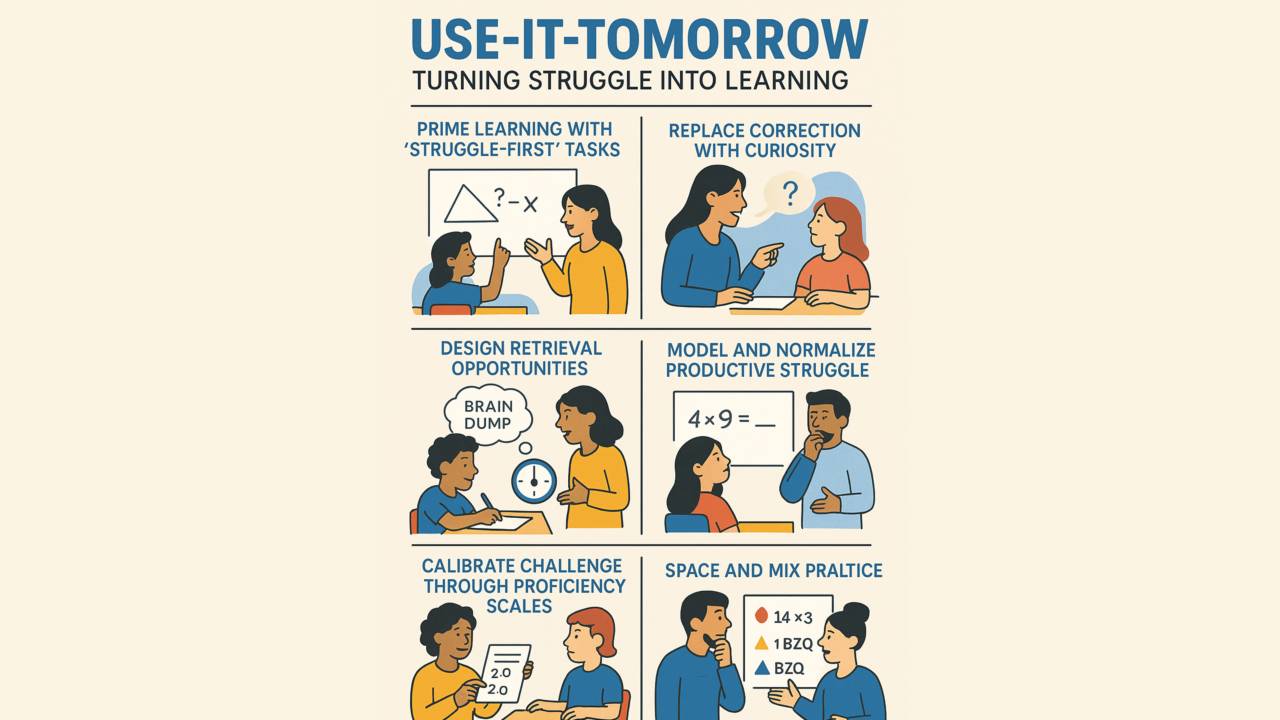
From Theory to Practice
In last week’s blog, When Learning Feels Hard: The Science of Productive Struggle, we explored how moments of effort and uncertainty are not obstacles to avoid but essential catalysts for lasting learning. Research from cognitive science, especially the work of Bjork & Bjork (2011) on desirable difficulties and Kapur (2008) on productive failure, shows that learning becomes more durable when students must retrieve, generate, and reorganize information rather than merely recognize it.
This week, we translate those ideas into classroom practice. The goal is to help students reinterpret struggle as progress and to help teachers design lessons where cognitive effort feels purposeful and rewarding. Each strategy below is simple enough to implement tomorrow yet grounded in the science that makes learning stick.
- Prime Learning with “Struggle-First” Tasks
Why it works:
Beginning with a challenging problem before direct instruction activates prior knowledge and surfaces misconceptions, students’ initial attempts prepare the brain to integrate feedback more effectively. Make sure to let students know the struggle is expected. That is the sign that learning must take place.
Try this tomorrow:
- Start class with a “What do you already know?” problem before introducing the concept. Example: In math, pose a multi-step problem that can’t be solved yet but invites reasoning.
- Ask: “Which parts of this problem feel familiar, and where are you unsure?”
- Connect your explanation to the insights and misconceptions revealed.
- Replace Correction with Curiosity
Why it works:
When teachers treat mistakes as opportunities for thinking rather than failures, they sustain metacognitive engagement and normalize exploration.
Try this tomorrow:
- Respond to an incorrect answer with: “Interesting. What made you think that?” or “What would have to be true for that to work?”
- Invite peers to analyze the reasoning, not the error itself.
- Celebrate insightful thinking moves, not just accuracy. When learners take the time to wrestle and wander to reach the answer, they often gain the clarity needed to see the simpler path they might have missed.
- Design Retrieval Opportunities
Why it works:
Effortful recall strengthens memory and understanding; recognition feels easier but builds only familiarity.
Try this tomorrow:
- End class with a two-minute “Brain Dump”. Ask students to record everything they remember from today’s lesson.
- Begin tomorrow with one retrieval question from yesterday’s learning.
- Use quick, no-grade quizzes to promote recall over rereading.
- Have learners generate questions about the day’s lesson, which you will shuffle and redistribute at the beginning of tomorrow’s lesson.
- Calibrate Challenge Through Proficiency Scales
Why it works:
When learners can locate themselves along a scale, they are more likely to persist. The structure clarifies what’s within reach and what foundational skills to revisit.
Try this tomorrow:
- Share the Level 2.0–3.0 bullets for your target skill.
- After an initial challenge, ask: “Which Level 2.0 skill would help you move forward?”
- Allow brief research, peer coaching, or re-teaching to bridge the gap.
- Model and Normalize Productive Struggle
Why it works:
Students internalize attitudes toward struggle by watching how adults navigate uncertainty.
Try this tomorrow:
- Model your thinking aloud while solving a novel problem: “I’m stuck here. So let me check what I already know.”
- Share a brief story of your own productive struggle.
- Create a “Struggle Wall” where students post examples of times they persisted and what they learned.
- Space and Mix Practice
Why it works:
Spacing and interleaving strengthen retrieval strength and transfer by requiring students to reconstruct learning in new contexts.
Try this tomorrow:
- Mix yesterday’s topic with today’s: Example: Combine questions from two science units in a single review.
- Begin class with a 90-second “Recall Burst,” in which students jot down everything they remember from a prior unit.
- Rotate problem types rather than blocking by similarity.
In Summary
Tomorrow’s best lessons might look a bit messy, but that is exactly the point. Struggle-first tasks, retrieval practice, and curiosity-driven feedback transform difficulty into cognitive engagement. When students learn to see effort as evidence of growth, they stop fearing mistakes and start owning their learning.
If you are interested in exploring more about productive struggle and other principles of cognitive engagement, or the strategies that support them in our classrooms, join the Learning Hub and post in the Community Channels, register to attend an office hour, or send a direct message to the Learning Hub Faculty.