Make Them Generate It: Why Creating Knowledge Beats Consuming It
Dec 18, 2025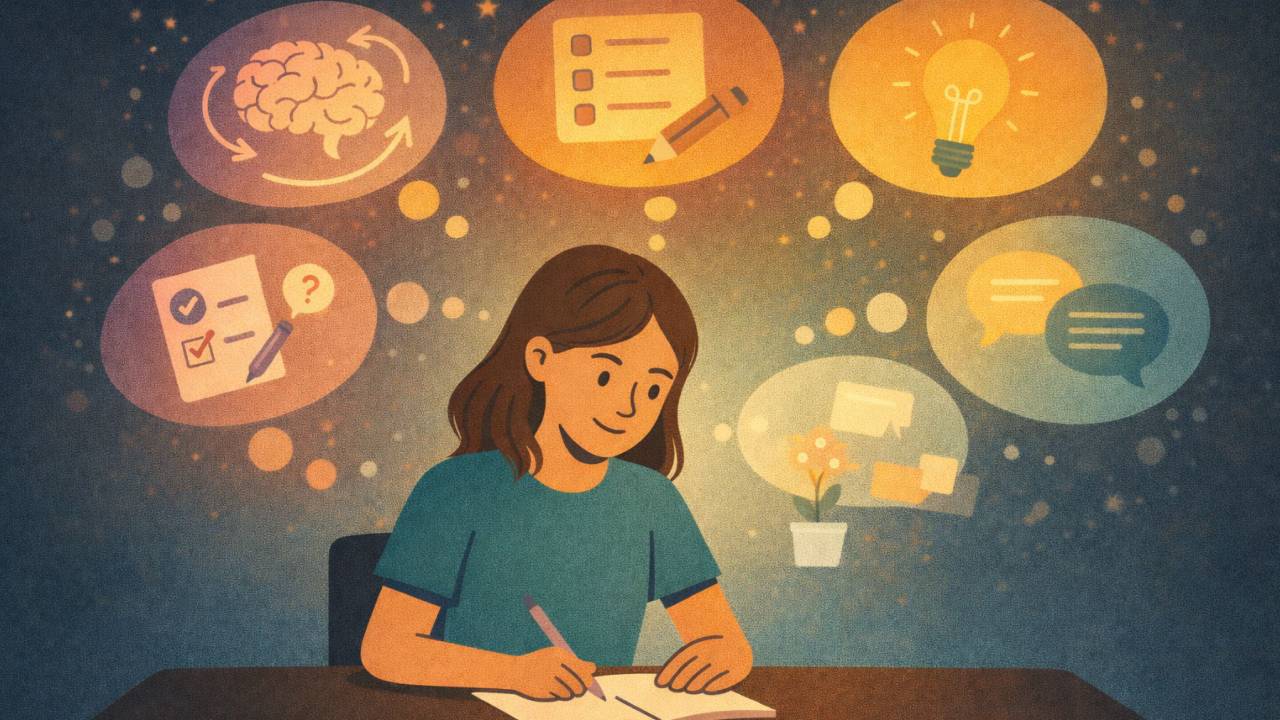
Teachers often design lessons that are clear, efficient, and well-explained. Slides are polished, models are precise, and examples are thoughtfully sequenced. Yet planning alone does not guarantee learning. Students can follow along, nod in agreement, and still retain very little of what was taught. Cognitive science reminds us that learning is not strengthened by exposure alone, but by what learners are required to generate as evidence of their understanding. They need to produce something from memory. This generation can include a spectrum of activities:
- Retrieval (recalling information from memory)
- Explanation (articulating understanding in one’s own words)
- Summarization (selecting and organizing key ideas)
- Prediction (anticipating outcomes based on understanding)
- Representation (drawing, modeling, mapping)
- Justification (defending a claim)
- Application (using knowledge in a new context)
Generation shifts students from consumers of information to constructors of meaning. When learners predict, explain, summarize, or attempt solutions before receiving answers, they engage in the mental work that makes learning stick.
Why Generation Matters for Learning
The generation effect, first identified by Slamecka and Graf (1978), demonstrates that information people generate themselves is remembered better than information they simply read or hear. This advantage persists even when generated responses are incomplete or partially incorrect. The act of generating requires learners to retrieve prior knowledge, test hypotheses, and organize ideas. They are all processes that deepen encoding and strengthen memory.
More recent research builds on this foundation. Fiorella and Mayer (2015) show that generative activities, such as explaining, drawing, predicting, questioning, and summarizing, promote deeper learning because they require learners to actively select, organize, and integrate information. These processes align with what cognitive scientists describe as germane cognitive load: the productive mental effort invested in building and refining knowledge structures. For more on cognitive load and generating thinking space, see last week’s blog.
In the Marzano Academies Instructional Model, this generation effect is addressed in Element IIIc—Recording and Representing. It is the third step in the continuous, teacher-directed instructional sequence of chunk–process–record/represent. When learners receive information without pause, without intentional chunking, or without processing that culminates in a generated representation of their understanding, the likelihood that learning will occur is diminished. In short, generation is not an add-on to instruction; it is a mechanism of learning itself.
Generation as Cognitive Engagement
Cognitive engagement is often difficult to observe. Thinking happens internally, and compliance can easily masquerade as understanding. Generation changes that dynamic. When students generate responses, their thinking becomes visible.
- A prediction reveals prior knowledge and assumptions.
- An explanation reveals conceptual understanding and misconceptions.
- A restatement reveals how well ideas have been organized and encoded.
- A question shows that a learner recognizes specific gaps in their knowledge.
Because generation requires effort, it also introduces a desirable level of difficulty. Learners must grapple with uncertainty, retrieve information from memory, and refine their thinking. This effort is precisely what strengthens learning.
From a cognitive engagement standpoint, generation is the behavioral evidence of internal processing. When a teacher asks learners to complete a task, it should be for the sole purpose of making the invisible process of thinking visible so that the evidence can be used to determine status within the learning progression and possible next steps for improvement. Showing the learner how to use the generated evidence as a guide to what’s next should be a common practice for all educators.
How the Marzano Academies Approach Supports Generation
The Marzano Academies model naturally amplifies the power of generation because it emphasizes clarity, progression, and evidence of learning rather than passive exposure.
Proficiency Scales Create a Reason to Generate
Proficiency scales clarify what learners are working toward and how learning progresses from acquiring foundational knowledge (2.0) to generate evidence of target performance (3.0) and beyond (4.0). When students understand these progressions, generation becomes purposeful.
Instead of asking, “What did the teacher say?” learners are prompted to consider:
- What can I explain/demonstrate at this level?
- What evidence shows I’m approaching or meeting the target?
Generation becomes a tool for self-assessment and progress monitoring, not just participation.
Assessment as Evidence of Thinking
In the Marzano Academies model, assessment is not about collecting points but about gathering evidence of learning. Generated responses, including oral explanations, written justifications, representations, and applications, provide rich insight into student understanding.
These artifacts allow teachers and learners to:
- Identify misconceptions revealed through explanation.
- Determine whether foundational knowledge is being retrieved or merely recognized.
- Adjust instruction based on what students can generate independently.
When students generate, teachers see learning in action. The Marzano Academies Instructional Model, specifically the seven elements of Design Area III (Proficiency Scale Instruction), helps teachers proactively plan lessons that move from teacher-directed instruction to student-led discovery. Planning in this intentional way encourages teachers to pause instruction and invite learners to process new ideas through prediction, explanation, questioning, or representation. These generative opportunities allow learners to connect new content to prior knowledge and deepen understanding before their working memory is tasked with applying that knowledge to make decisions, solve problems, or defend reasoning.
Design Area IV (General Instruction), which can be understood as the adaptive execution of the lesson based on evidence of student thinking, extends generation through practice, application, and refinement across varied contexts. This structure ensures that generation is not episodic, but embedded throughout the learning cycle.
What Generation Looks Like in Practice
Effective generative tasks do not require elaborate redesign. Small shifts in sequencing can produce large gains in engagement and retention:
- Predict before demonstrating. Ask students to anticipate outcomes before showing a solution or experiment.
- Restate before revealing. Invite learners to summarize a concept in their own words before the teacher provides the formal explanation.
- Explain the “why.” Prompt students to justify answers rather than simply state them.
- Generate examples or non-examples. This forces learners to apply criteria rather than recall definitions.
In each case, the goal is the same: require students to think first, then refine.
In Summary
Learning is not strengthened by how clearly information is delivered, but by how actively it is processed. The generation effect shows that creating knowledge—through prediction, explanation, and representation—leads to stronger memory, deeper understanding, and greater transfer.
By pairing generative learning strategies with clear proficiency scales and evidence-based assessment, the Marzano Academies approach ensures that cognitive engagement is not assumed, but demonstrated. When learners generate, their thinking becomes visible, their understanding deepens, and engagement moves from behavioral to cognitive.
Cognitive engagement, after all, isn’t about seeing action. It’s about generating evidence of learning.
To continue building your understanding of these instructional elements, you may want to explore one of the Learning Hub’s Badging Experiences or subscribe to the Learning Lab for access to professional development resources, including Dr. Marzano’s research folios for each element and a community of educators working to make their classrooms centered on competency-based practices. These resources are designed to help you identify a meaningful professional growth goal and develop a clear plan for strengthening your practice. As we often say, teachers should own their professional learning.
References
Fiorella, L., & Mayer, R. E. (2015). Learning as a generative activity: Eight learning strategies that promote understanding. Cambridge University Press.
Slamecka, N. J., & Graf, P. (1978). The generation effect: Delineation of a phenomenon. Journal of Experimental Psychology: Human Learning and Memory, 4(6), 592–604.