Measuring Learning Status
Too often, proficiency scales get labeled as a grading reform tool. It’s easy to see why—many educators encounter them in the context of standards-based grading. But here’s the truth: the real power of a proficiency scale isn’t in grading. It’s in measuring learning.
Think of it this way: a proficiency scale is like a ruler. A ruler doesn’t care whether you report distance in inches, centimeters, or miles—it simply measures. In the same way, a proficiency scale measures a learner’s status on their learning journey. Are they just starting out? Do they know the basics? Are they showing deeper understanding? The reporting format—letters, percentages, narrative statements—can flex to fit your community’s expectations.
Dr. Marzano has even developed a conversion scale (link) which you can edit to fit your grading system. Want a 3.0 to equal a 93? Just adjust the column. The point is: proficiency scales don’t dictate how you report learning—they help you understand where a learner is in the progression.
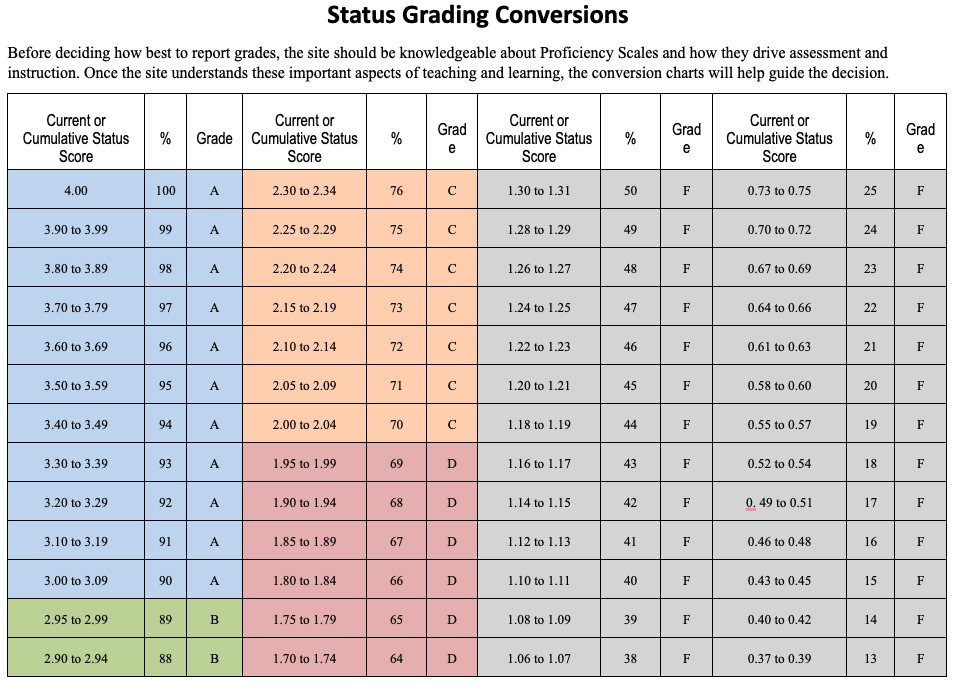
At its core, the scale helps answer two critical questions:
-
Has the learner demonstrated proficiency with the concept or skill—retrieving knowledge and applying it without major errors?
-
If yes, they’re at the target (Scale Level 3.0).
-
-
-
If yes, their status is “knowledgeable” (Scale Level 2.0), and the teacher’s work is to help them deepen, apply, and extend their understanding.
-
If no, their status is below 2.0, and the immediate focus should be on building essential knowledge.
If not, can the learner at least retrieve the foundational knowledge?
-
In short, a proficiency scale is not primarily a grading tool; it’s a learning tool. Its real value lies in showing a learner’s status in the progression: from not yet knowing, to retrieving foundational knowledge, to demonstrating full understanding and application. This clarity helps teachers know exactly what should happen next in instruction, while still allowing schools to report progress in whatever format their community prefers.
Want to go Deeper
- Full subscribers get access to the complete folio and video library on Engaging Learners in Cognitively Complex Content, which shows exactly how to move students from knowledge to application.
Already a member:
- Join the conversation in our Community Channels, attend faculty office hours, or message us directly inside the Learning Hub.
Thanks. Enjoy the Learning.
- Learning Hub Faculty.
Responses